Beaverton’s City Council Monday night unanimously rejected plans to build a new Wal-Mart store in Cedar Mill.
Wednesday, August 09, 2006
Beaverton, OR Says No to Wal-Mart
Announced in the The Times.


More on the Wage Increase
When Wal-Mart reported that they were 'capping' wages in all of their job categories I naively assumed they would still give 'cost of living increases'. But, it's more like long-time employees are being forced to give up wage increases (unless they change positions) so that money can go to starting employees.
Go here and read some of the comments from real Wal-Mart employees (although they are probably just disaffected union stooges). I guess Wal-Mart employees just don't get the 'Free Market'.
Does the wage cap apply to Wal-Mart executives?
Go here and read some of the comments from real Wal-Mart employees (although they are probably just disaffected union stooges). I guess Wal-Mart employees just don't get the 'Free Market'.
Does the wage cap apply to Wal-Mart executives?
Tuesday, August 08, 2006
Wal-Mart Public Relations
It would be interesting to know how much Wal-Mart pays for Public Relations advice. They sure aren't getting much bang for their buck. Look at 'PaidCritics.com', Wal-Mart's gunslinger critics that are paid to criticize Wal-Mart's critics (boyoboy that is complicated). They are having a ball criticizing WakeUpWalMart's bus tour of the country and some of the Democrats that show up at each stop.
Isn't there some Wal-Mart VP in charge of overseeing these guys? Maybe Wal-Mart could get better PR if they outsourced their PR overseas. They could save money at the same time.
"It’s time for the Paid Critics and their candidates to stop playing politics and start offering real solutions to the challenges facing working men and women across this country."I agree. It's time for someone to start offering real solutions to the challenges facing working men and women in this country. Where are the Republicans? They hold all the power. They control the government. They were elected with dollars provided by Wal-Mart. They have been in power for over 5 years. When will they start offering real solutions?
Isn't there some Wal-Mart VP in charge of overseeing these guys? Maybe Wal-Mart could get better PR if they outsourced their PR overseas. They could save money at the same time.
The Writing On The Wal
One of my favorite Wal-Mart information websites is "The Writing On The Wal". I like it because it is written by independent, intelligent, unpaid bloggers and because they always have the most up-to-date info on all things Wal-Mart. I encourage visits to that website for anyone that wants to read well written commentary on Wal-Mart.
I read Walmart Watch and WakeUpWalmart too, which are union supported websites. But I tend not to cite them too much for the same reasons that I discount what I read on Walmartfacts, Working families for WalMart and Paidcritics (all paid by Wal-Mart).
I read Walmart Watch and WakeUpWalmart too, which are union supported websites. But I tend not to cite them too much for the same reasons that I discount what I read on Walmartfacts, Working families for WalMart and Paidcritics (all paid by Wal-Mart).
Wal-Mart Raises Wages
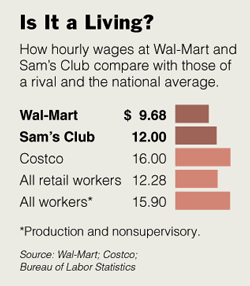
Wal-Mart has announced that starting employees deserve a pay increase "based entirely on wage surveys in every market where we do business".
 2005 Data
Wal-Mart profit margin 3.6%
Costco profit margin 1.9%
The nation's largest private employer is rolling out an average pay increase of 6% for new hires at 1,200 Wal-Mart and Sam's Club warehouse stores nationwide, including some of its nearly 200 stores in California.This is in spite of the fact that Wal-Mart has long claimed that it cannot afford higher wages for its employees. However, you do not want to remain a shelf stocker, greeter or cashier forever. The new policy also means move up in the ranks or your salary remains stagnant.
Wal-Mart is instituting the salary caps to encourage workers to move up through the ranks rather than remain in the same job for years. Employees who earn more than the maximum amount for their job won't see a salary decrease but will no longer be entitled to raises unless they change positions.Heavy criticism of Wal-Mart and loss of 8% of its customers may actually be making Wal-Mart re-think its business strategy.
The announcement by Wal-Mart comes as the company continues its battles against legislative oversight of how it treats workers.
 2005 Data
Wal-Mart profit margin 3.6%
Costco profit margin 1.9%
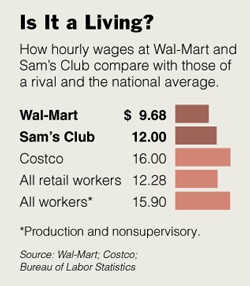
BusinessWeek ran through the numbers from each company to compare Costco and Sam's Club, the Wal-Mart warehouse unit that competes directly with Costco. We found that by compensating employees generously to motivate and retain good workers, one-fifth of whom are unionized, Costco gets lower turnover and higher productivity. Combined with a smart business strategy that sells a mix of higher-margin products to more affluent customers, Costco actually keeps its labor costs lower than Wal-Mart's as a percentage of sales, and its 68,000 hourly workers in the U.S. sell more per square foot. Put another way, the 102,000 Sam's employees in the U.S. generated some $35 billion in sales last year, while Costco did $34 billion with one-third fewer employees.
Yet the cheap-labor model turns out to be costly in many ways. It can fuel poverty and related social ills and dump costs on other companies and taxpayers, who indirectly pick up the health-care tab for all the workers not insured by their parsimonious employers. What's more, the low-wage approach cuts into consumer spending and, potentially, economic growth. "You can't have every company adopt a Wal-Mart strategy. It isn't sustainable," says Rutgers University management professor Eileen Appelbaum
Monday, August 07, 2006
Advice to the Poor
"it's not Wal-Mart's fault that its associates are poor. "You see these people are poor because:
(paraphrased)
1) They charged too much on their credit cards.
2) Had kids and now can't support them.
3) Didn't get an education.
4) Failed to save for the future.
5) Made unnecessary purchases.
Can anyone think of other reasons why people are poor and should be punished or abandoned? Maybe you add some more good advice for the poor.
con't. "If they had made the correct choices in life, the wages they receive would be sufficient to sustain them and they would be on their way to better lives".Yes, you can easily live on the wage Wal-Mart pays you if:
1) Tear up all those credit cards
2) Give the kids up for adoption and get sterilized
3) Go to medical school or law school
4) Save up at least 50% of all the money your poor relatives give you
5) Don't buy unnecessary stuff. Wait, forget that last one, Wal-Mart wants you to buy unecessary stuff.
Then just live on the $320 (minus taxes and health insurance) you take home everyweek.
(No this isn't from me, it came from a pro-Wal-Mart blog. With friends like that, Wal-Mart really doesn't need any enemies.)
Does Criticism of Wal-Mart Effect Anything?
Today at the Washington Post:
Or consider the environmental behavior of U.S. companies at home. This used to be the classic case of politics leading business: For most of the past generation, regulators have forced environmental rules on grumbling corporations. But in the current debate on climate change, this order has reversed itself. Impatient companies are capping their own carbon emissions: Wal-Mart has promised to double the efficiency of its vehicle fleet and achieve a 30 percent cut in its stores' energy usage. Its motive is not complicated. Internet-enabled critics have assaulted Wal-Mart, and the firm's polling has suggested that 8 percent of shoppers have quit visiting its outlets because of its stance on social issues. An environmental makeover was essential to the brand.
The Dark Heart of Wal-Mart
From the Houston Chronicle last year, an article about keeping employee tenure short at Wal-Mart. Lots of part-time employees and a high employee turnover rate of 50% a year helps keep wages and benefits down at Wal-Mart. This is the primary basis of their Always low prices. Always business model. Other retailers must do the same to compete with the giant. Wal-Mart suppliers keep costs down by shipping jobs overseas.
Wal-Mart is not alone in struggling with these costs. But its proposed solutions reveal the company's dark heart. It's extracting the cost from those who can least afford it.Wal-Mart makes people poor.
Business doesn't look back. Wal-Mart led the charge from the town square to the edge of town. It trained us to believe that the cost of our purchases was all that mattered. Somewhere along the road, the company started believing that, too.
It taught us to expect low prices — always. Chambers' memo shows a company that believes in the low price at any cost.
During the last decade, dependence on the food stamp program nationwide increased by 8 percent, while in counties with Wal-Mart stores the increase was almost twice as large at 15.3 percent, according to the study. Although Wal-Mart employs many people living in its communities, for most, the hours worked and the wages paid do not help these families transition out of poverty, the study said.This article from The Globalist, a syndication of the San Jose Mercury News and the Boston Globe compares and contrasts Wal-Mart with General Motors.
No company of Wal-Mart's size and influence can long remain a truly private enterprise. By its very existence and competitive success, it rezones our cities, determines the real minimum wage, channels capital throughout the world — and conducts a kind of international diplomacy with a score of nations.
In short, the company's management "legislates" for the rest of us key components of U.S. social and industrial policy.
Friday, August 04, 2006
Bus Tour Stories
WakeUpWalmart started a bus tour of the USA last Tuesday. It's purpose is to educate citizens about corporate responsibility, living wages and a fair workplace. Yeah, yeah, I know that Wakeupwalmart is funded by the evil unions and it's not fair for workers to band together to fight multi-billion dollar corporations. Afterall, Wal-Mart has an 'open door policy'. And, that the bus tour is more about politics than people (Wal-Mart talking point). It never ceases to amaze me that Wal-Mart, the largest, richest company on earth, whines about being picked on. But be that as it may, here are a couple of stories concerning the bus tour.
Long, Hot Summer for Wal-Mart by Liza Featherstone (BTW, she points to a link to a story at Fortune Magazine concerning Wal-Mart and goal to clean up its environmental record.
The Bus tour's Baltimore stop.
Wal-Mart's paid PR lackies at Edelman's 'Paidcritics' are very upset about all this political nonsense. Afterall, it's Democrat politicians showing up at the bus tour stops and not Republicans.
Wal-Mart has a lot more money invested in Republican senators and congressmen including our own John Sweeney and John McHugh than they do in Democrat congressmen and women. They depend on Republicans to prevent a minimum wage hike and to promote the abolishment of the Estate Tax.
Percentage of Wal-Mart PAC money to Republicans in 2000 was 85%, 2002 was 78%, 2004 was 78% and thus far in 2006 is 70% (they need to start buying some Democrats now that the winds appear to be shifting).
Long, Hot Summer for Wal-Mart by Liza Featherstone (BTW, she points to a link to a story at Fortune Magazine concerning Wal-Mart and goal to clean up its environmental record.
The Bus tour's Baltimore stop.
Wal-Mart's paid PR lackies at Edelman's 'Paidcritics' are very upset about all this political nonsense. Afterall, it's Democrat politicians showing up at the bus tour stops and not Republicans.
Wal-Mart has a lot more money invested in Republican senators and congressmen including our own John Sweeney and John McHugh than they do in Democrat congressmen and women. They depend on Republicans to prevent a minimum wage hike and to promote the abolishment of the Estate Tax.
Percentage of Wal-Mart PAC money to Republicans in 2000 was 85%, 2002 was 78%, 2004 was 78% and thus far in 2006 is 70% (they need to start buying some Democrats now that the winds appear to be shifting).
Thursday, August 03, 2006
Wal-Mart, Salmon and Environmental Defense
This post (on The Writing On the Wal blog), concerning Environmental Defense opening an office in Bentonville, AR, immediately caught my attention today.
Wal-Mart has started a campaign to be more environmentally friendly because it saves the company money in the long run and gives them badly needed PR. You can read all about the new 'green' Wal-Mart here.
Wal-Mart is one of the biggest sellers of farmed seafood in the world, but they have been criticized (a chapter from Charles Fishmans book, The Wal-Mart Effect) for the effects on the environment of these fish farms, especially salmon farms in Chile. [Note: careful about reading this article, you may never eat farmed salmon again.] Environmental Defense on the other hand, has an ongoing campaign to change the fish farming industry. Environmenal Defense goes so far as to claim that eating farmed salmon could be harmful to your health. Several months ago, Wal-Mart vowed to only sell fish obtained from environmentally sound sources.
Lee Scott wants the fish farming industry to raise it's standards, but the fish farming industry farms the way it does because Wal-Mart forces them to cut costs.
Wal-Mart has started a campaign to be more environmentally friendly because it saves the company money in the long run and gives them badly needed PR. You can read all about the new 'green' Wal-Mart here.
In Wal-Mart’s case, Environmental Defense was one of several groups Wal-Mart contacted in early 2005 to help formulate a green policy unveiled by Scott last October. Under that plan, Wal-Mart set goals of using 100 percent renewable energy, creating zero waste and selling more products that sustain the environment.Environmental Defense is the group that got MacDonald's to stop using styrofoam containers in packaging their food. So they can be an effective organization. They often use economic arguments to convince companies that it is cost-effective to do what is right concerning the environment. However, it's easy for Wal-Mart to require that suppliers not let their truck engines idle while making deliveries or to change store lighting to save on energy costs. But other recommended changes may require Wal-Mart to do things that are against the Wal-Mart 'Always low prices, always' culture.
Wal-Mart is one of the biggest sellers of farmed seafood in the world, but they have been criticized (a chapter from Charles Fishmans book, The Wal-Mart Effect) for the effects on the environment of these fish farms, especially salmon farms in Chile. [Note: careful about reading this article, you may never eat farmed salmon again.] Environmental Defense on the other hand, has an ongoing campaign to change the fish farming industry. Environmenal Defense goes so far as to claim that eating farmed salmon could be harmful to your health. Several months ago, Wal-Mart vowed to only sell fish obtained from environmentally sound sources.
The world's largest retailer has pledged that all of its U.S. fresh and frozen fish, excluding farmed fish, will eventually come from fisheries certified as being "sustainable" by the Marine Stewardship Council, meaning that the sea areas they come from are not being over-fished.So here is a question for Environmental Defense and for Wal-Mart. (1) Is Wal-Mart going to require it's suppliers of farmed salmon to follow the salmon fish farming recommendations of Environmental Defense? (2) Will Wal-Mart allow the fish farmers to raise their prices to cover these changes?
Lee Scott wants the fish farming industry to raise it's standards, but the fish farming industry farms the way it does because Wal-Mart forces them to cut costs.
Part of the reason Wal-Mart can sell a salmon fillet for $4.84 is that, as Leape puts it, "they don't internalize all the costs." Pollution ultimately costs money--to clean up, to prevent, to recover from. But right now those costs aren't in the price of a pound of Chilean salmon. (From the Fishman article)An MSNBC web poll shows that 61% of respondents don't believe that Wal-Mart will live up to its environmental pledge.
Wednesday, August 02, 2006
Ballston, NY Rejects Wal-Mart
From the Albany Times Union:
The Town Council said "game over" Tuesday to Wal-Mart and its plans to build a super center on Route 50.
By a unanimous vote, the council rejected Wal-Mart's application, resulting in an eruption of cheers and standing ovations from residents.
Before the vote, Albany attorney Mary Beth Slevin, who represented Wal-Mart's proposal, said the retail giant looked forward to working with the Town Council. She was unavailable for comment after the vote.
Councilwoman Mary Beth Hynes, meanwhile, had challenged fellow board members to take a position on the proposed Wal-Mart.
"I urge my fellow board members to join me tonight in sending an unambiguous message that, as far as the town of Ballston is concerned, the door will be closed to Wal-Mart and big-box development once and for all," she said in a prepared statement.
Wal-Mart Discussion on Local TV
Mountain Lake PBS will air a panel discussion on the local Wal-Mart issue this Friday evening at 8:30 PM. It will be an episode of Mountain Lake Journal and the panel will consist of Brian Mann (NCPR), Jack LaDuke (WCAX-TV) and Peter Crowley (Adirondack Daily Enterprise). I believe the episode will also be shown on Saturday at 7 PM.
Tuesday, August 01, 2006
Wal-Mart Job or Manufacturing Job?
1954: Huffy opens the Celina, Ohio, plant. At its peak, the plant produced 1 million bikes a year.
1998: Pressure from Wal-Mart forces Huffy to close the bicycle plant in Celina, putting 1,100 employees out of work. The jobs were moved to a nonunion factory in Missouri.
1999: Huffy, pressured to continue lowering costs, closes its last two U.S. bicycle plants—in Farmington, Mo., and Southaven, Miss. The move eliminates 600 jobs. The company contracts with fac-tories in Mexico and China.
2001: Huffy ends its manufacturing contracts with Mexico and begins relying almost entirely onfactories in China, where Chinese workers earn only 33 cents an hour and frequently work sevendays a week.
Wal-Mart creates good jobs? I bet Ruth Schumacher and her husband would disagree. Now Mr. and Mrs. Schumacher are dependent on Wal-Mart's everyday low prices.
Maybe if we all get minimum wage jobs, Wal-Mart will give their stuff away.
1998: Pressure from Wal-Mart forces Huffy to close the bicycle plant in Celina, putting 1,100 employees out of work. The jobs were moved to a nonunion factory in Missouri.
1999: Huffy, pressured to continue lowering costs, closes its last two U.S. bicycle plants—in Farmington, Mo., and Southaven, Miss. The move eliminates 600 jobs. The company contracts with fac-tories in Mexico and China.
2001: Huffy ends its manufacturing contracts with Mexico and begins relying almost entirely onfactories in China, where Chinese workers earn only 33 cents an hour and frequently work sevendays a week.
Wal-Mart creates good jobs? I bet Ruth Schumacher and her husband would disagree. Now Mr. and Mrs. Schumacher are dependent on Wal-Mart's everyday low prices.
Laid-off factory worker Ruth Schumacher rises before the sun most days and earns $7 per hour tending the breakfast bar at a Holiday Inn in Celina, Ohio. She would like to set out a tip jar for the occasional dollar, but management forbids it.Wal-Mart's response?
After work, she occasionally goes next door to shop at Wal-Mart or at Kmart one town away.
“They’ve got real good bargains,” she said of Wal-Mart, echoing a generation of thrifty shoppers.
Never mind that Wal-Mart is a major reason Schumacher no longer has a $12-per-hour job at Huffy Corp.’s bicycle plant. Five years ago, Wal-Mart pressured Huffy to lower the cost of its bikes, so Huffy closed its Celina plant. Schumacher’s job and the job her husband held at Huffy eventually ended up in China.
“We are in business to take care of the customer,” spokeswoman Melissa Berryhill said. “We are going to do what we need to do to deliver everyday low prices to our customers, and we are going to go where we have to go in order to do that.”So to get low prices Wal-Mart ships good jobs overseas thereby creating more poor people that need their everyday low prices. Excellent strategy.
Maybe if we all get minimum wage jobs, Wal-Mart will give their stuff away.
Questions Wal-Mart's Effect on the Economy
Speaking from the heartland, Etson Hougland, suggests that Wal-Mart should be under greater scrutiny:
I'm no fan of GW Bush, but I think others deserve more credit for the current state of labor (Reagan). But Bush hasn't done a whole lot to get the Chinese to more fairly adjust the value of their currency against the US dollar either.
He does make the point that we need more insight into the effects of Wal-Mart on our economy. Charles Fishman (The Wal-Mart Effect) did not get much help from Wal-Mart when writing his book. Wal-Mart Corporation is famously secretive. Fishman couldn't even get Wal-Mart suppliers to comment on their relationships with Wal-Mart.
Wal-Mart not only dictates the price, it also dictates the terms, conditions, source and in some cases the material used in the products it purchases. It has been the leading exponent of forcing American firms to move production of products to a Communist “slave labor” state – China. It is using its economic power to orchestrate the destruction of American industry. Its economic power is used to destroy local independent merchants in virtually every community in which it operates.He goes on to point out that China deliberately pegs it's currency at a very low value resulting in products being imported into the USA 30-40% below their actual value.
In conjunction with this power, Wal-Mart provides substandard pay, medical and retirement benefits to its hundreds of thousands of employees while denying them the option of obtaining union representation. The Bush administration has taken countless legal steps designed to weaken the power of labor and destroy any vestige of legal representation for the working people of this nation. This policy combined with a suicidal unfair trade policy has allowed multinational corporations to exploit slave labor in order to undermine our nation’s entire economic and benefits system.
I'm no fan of GW Bush, but I think others deserve more credit for the current state of labor (Reagan). But Bush hasn't done a whole lot to get the Chinese to more fairly adjust the value of their currency against the US dollar either.
He does make the point that we need more insight into the effects of Wal-Mart on our economy. Charles Fishman (The Wal-Mart Effect) did not get much help from Wal-Mart when writing his book. Wal-Mart Corporation is famously secretive. Fishman couldn't even get Wal-Mart suppliers to comment on their relationships with Wal-Mart.
Monday, July 31, 2006
Wal-Mart in China Creates a Union
Canadian Wal-Mart workers unionized in Jonquiere,Quebec. Wal-Mart promptly closed the store. Now Chinese Wal-Mart workers have formed a union.
The Wal-Mart workers were reported to have set up the union in Jinjiang, Quanzhou, in Fujian province.Will Wal-Mart close that store? I doubt it. Wal-Mart can't afford to alienate China.
Friday, July 28, 2006
Opposing Opinions: Facts vs Fiction
There are two 'guest editorials' printed in todays Adirondack Daily Enterprise (UPDATE: Links have now been added). Both are well written, but couldn't be more different. They are not different because they disagree on Wal-Mart locating to Saranac Lake.
One editorial is by Mr. Lee Keet, replying to a guest editorial written by Susan Seaward earlier in the week. Unlike Ms. Seaward, Mr. Keet uses facts and figures from specific sources to explain why he thinks Wal-Mart may not be in the best interest of Saranac Lake and the surrounding communities. Mr. Keet ends his editorial asking area residents to work together to bring a retail business that will be consistent with the character of our community.
The other editorial is by Mr. Donald G. Perryman. He points out that generations (natives) of 'adirondackers' have taken care of our environment and resources, not the 'tree huggers', 'preservationists' and 'do-gooders' (transplants). So we should trust their judgement in "managing and planning regarding the park". "The larger villages provide a kind of oasis in the wilderness where residents can acquire the goods and services that fulfil their needs". So it makes sense that any retailer that wants to locate here should be welcomed with open arms. If the experts say they need a 121,000 sq ft facility, that should be good enough for us. They are the experts you see. Welcoming Wal-Mart is an opportunity to 'revitalize' the Village of Saranac Lake. The local merchants will benefit from this. Mr. Perryman tells us what he 'thinks' will happen.
Do you see the difference between the two editorials? Fact vs wishes (maybe even fiction), certainly facts vs 'what I think' or, in the case of Ms. Seaward, what Wal-Mart tells me.
This is the basis of the debate about Wal-Mart locating to Saranac Lake. At least 60% of village residents are concerned about the possible effects of a large Wal-Mart on our community. They have read articles, reports etc that justifies their concerns.
On the other side, Wal-Mart supporters want a cheap, one-stop place to shop period. They don't really care about the possible effects of a super retailer on our community. But they can't just come out and say that. So they come up with 'soundbites' based on 'what they think', truthiness or wishful thinking.
Let's see some facts, independent of Wal-Mart, that show how Wal-Mart will be good for Saranac Lake. That's what 3/5's of the Village Board want also.
One editorial is by Mr. Lee Keet, replying to a guest editorial written by Susan Seaward earlier in the week. Unlike Ms. Seaward, Mr. Keet uses facts and figures from specific sources to explain why he thinks Wal-Mart may not be in the best interest of Saranac Lake and the surrounding communities. Mr. Keet ends his editorial asking area residents to work together to bring a retail business that will be consistent with the character of our community.
The other editorial is by Mr. Donald G. Perryman. He points out that generations (natives) of 'adirondackers' have taken care of our environment and resources, not the 'tree huggers', 'preservationists' and 'do-gooders' (transplants). So we should trust their judgement in "managing and planning regarding the park". "The larger villages provide a kind of oasis in the wilderness where residents can acquire the goods and services that fulfil their needs". So it makes sense that any retailer that wants to locate here should be welcomed with open arms. If the experts say they need a 121,000 sq ft facility, that should be good enough for us. They are the experts you see. Welcoming Wal-Mart is an opportunity to 'revitalize' the Village of Saranac Lake. The local merchants will benefit from this. Mr. Perryman tells us what he 'thinks' will happen.
Do you see the difference between the two editorials? Fact vs wishes (maybe even fiction), certainly facts vs 'what I think' or, in the case of Ms. Seaward, what Wal-Mart tells me.
This is the basis of the debate about Wal-Mart locating to Saranac Lake. At least 60% of village residents are concerned about the possible effects of a large Wal-Mart on our community. They have read articles, reports etc that justifies their concerns.
On the other side, Wal-Mart supporters want a cheap, one-stop place to shop period. They don't really care about the possible effects of a super retailer on our community. But they can't just come out and say that. So they come up with 'soundbites' based on 'what they think', truthiness or wishful thinking.
Let's see some facts, independent of Wal-Mart, that show how Wal-Mart will be good for Saranac Lake. That's what 3/5's of the Village Board want also.
SAGA Opens Informational Storefront
Announcement from SAGA.
Store Front OpensResidents concerned about out-of-scale retail development in Saranac Lake are willing to put their time/money where their mouth is. Homemade signs, informational storefronts, organizations, community store development etc., they don't need the support of the largest corporation on earth to get their message out there.
On Tuesday July 25, 2006, SAGA unveiled its new downtown Saranac Lake storefront located at 29 Broadway. SAGA's intent is to use the location, window space and a small portion of the interior as an "information center" promoting appropriate retail development, continuing efforts to establish a size cap for retail spaces, and furthering its education campaign as to the impacts of inappropriately sized big-box retailers in the Saranac Lake area.
Information will be posted on the storefront window and there will be an effort to staff the space on a limited basis, depending on available volunteer help. It should be noted that SAGA is paying rent for this space and that it is supported by local dollars - not some multi-billion dollar mega-corporation from someplace like Arkansas.
There is an effort on the part of Wal-Mart and its supporters to influence the community with inaccurate, misleading, and deceiving "information." Wal-Mart has ramped up its PR campaign, perpetuating myths that are not grounded in any reality. They have found some local folks to believe them and even repeat them. The storefront will be focused on giving accurate information about the impacts (positive and negative) of different sized retailers on the community of Saranac Lake.
Although SAGA is not specifically opposed to Wal-Mart, we are very critical of its oversized proposal and the damaging effect it will have on Saranac Lake. We make it no secret that if they size a store appropriately, we will not oppose Wal-Mart. However, Wal-Mart and representatives of the local Wal-Mart support group, CARD, have shown no interest in discussing a reasonably sized store - they make it clear that they only support a 121,000-sq-ft Wal-Mart Super Center. We have seen no desire on their part to compromise.
Subscribe to:
Posts (Atom)