Or consider the environmental behavior of U.S. companies at home. This used to be the classic case of politics leading business: For most of the past generation, regulators have forced environmental rules on grumbling corporations. But in the current debate on climate change, this order has reversed itself. Impatient companies are capping their own carbon emissions: Wal-Mart has promised to double the efficiency of its vehicle fleet and achieve a 30 percent cut in its stores' energy usage. Its motive is not complicated. Internet-enabled critics have assaulted Wal-Mart, and the firm's polling has suggested that 8 percent of shoppers have quit visiting its outlets because of its stance on social issues. An environmental makeover was essential to the brand.
Monday, August 07, 2006
Does Criticism of Wal-Mart Effect Anything?
Today at the Washington Post:


The Dark Heart of Wal-Mart
From the Houston Chronicle last year, an article about keeping employee tenure short at Wal-Mart. Lots of part-time employees and a high employee turnover rate of 50% a year helps keep wages and benefits down at Wal-Mart. This is the primary basis of their Always low prices. Always business model. Other retailers must do the same to compete with the giant. Wal-Mart suppliers keep costs down by shipping jobs overseas.
Wal-Mart is not alone in struggling with these costs. But its proposed solutions reveal the company's dark heart. It's extracting the cost from those who can least afford it.Wal-Mart makes people poor.
Business doesn't look back. Wal-Mart led the charge from the town square to the edge of town. It trained us to believe that the cost of our purchases was all that mattered. Somewhere along the road, the company started believing that, too.
It taught us to expect low prices — always. Chambers' memo shows a company that believes in the low price at any cost.
During the last decade, dependence on the food stamp program nationwide increased by 8 percent, while in counties with Wal-Mart stores the increase was almost twice as large at 15.3 percent, according to the study. Although Wal-Mart employs many people living in its communities, for most, the hours worked and the wages paid do not help these families transition out of poverty, the study said.This article from The Globalist, a syndication of the San Jose Mercury News and the Boston Globe compares and contrasts Wal-Mart with General Motors.
No company of Wal-Mart's size and influence can long remain a truly private enterprise. By its very existence and competitive success, it rezones our cities, determines the real minimum wage, channels capital throughout the world — and conducts a kind of international diplomacy with a score of nations.
In short, the company's management "legislates" for the rest of us key components of U.S. social and industrial policy.
Friday, August 04, 2006
Bus Tour Stories
WakeUpWalmart started a bus tour of the USA last Tuesday. It's purpose is to educate citizens about corporate responsibility, living wages and a fair workplace. Yeah, yeah, I know that Wakeupwalmart is funded by the evil unions and it's not fair for workers to band together to fight multi-billion dollar corporations. Afterall, Wal-Mart has an 'open door policy'. And, that the bus tour is more about politics than people (Wal-Mart talking point). It never ceases to amaze me that Wal-Mart, the largest, richest company on earth, whines about being picked on. But be that as it may, here are a couple of stories concerning the bus tour.
Long, Hot Summer for Wal-Mart by Liza Featherstone (BTW, she points to a link to a story at Fortune Magazine concerning Wal-Mart and goal to clean up its environmental record.
The Bus tour's Baltimore stop.
Wal-Mart's paid PR lackies at Edelman's 'Paidcritics' are very upset about all this political nonsense. Afterall, it's Democrat politicians showing up at the bus tour stops and not Republicans.
Wal-Mart has a lot more money invested in Republican senators and congressmen including our own John Sweeney and John McHugh than they do in Democrat congressmen and women. They depend on Republicans to prevent a minimum wage hike and to promote the abolishment of the Estate Tax.
Percentage of Wal-Mart PAC money to Republicans in 2000 was 85%, 2002 was 78%, 2004 was 78% and thus far in 2006 is 70% (they need to start buying some Democrats now that the winds appear to be shifting).
Long, Hot Summer for Wal-Mart by Liza Featherstone (BTW, she points to a link to a story at Fortune Magazine concerning Wal-Mart and goal to clean up its environmental record.
The Bus tour's Baltimore stop.
Wal-Mart's paid PR lackies at Edelman's 'Paidcritics' are very upset about all this political nonsense. Afterall, it's Democrat politicians showing up at the bus tour stops and not Republicans.
Wal-Mart has a lot more money invested in Republican senators and congressmen including our own John Sweeney and John McHugh than they do in Democrat congressmen and women. They depend on Republicans to prevent a minimum wage hike and to promote the abolishment of the Estate Tax.
Percentage of Wal-Mart PAC money to Republicans in 2000 was 85%, 2002 was 78%, 2004 was 78% and thus far in 2006 is 70% (they need to start buying some Democrats now that the winds appear to be shifting).
Thursday, August 03, 2006
Wal-Mart, Salmon and Environmental Defense
This post (on The Writing On the Wal blog), concerning Environmental Defense opening an office in Bentonville, AR, immediately caught my attention today.
Wal-Mart has started a campaign to be more environmentally friendly because it saves the company money in the long run and gives them badly needed PR. You can read all about the new 'green' Wal-Mart here.
Wal-Mart is one of the biggest sellers of farmed seafood in the world, but they have been criticized (a chapter from Charles Fishmans book, The Wal-Mart Effect) for the effects on the environment of these fish farms, especially salmon farms in Chile. [Note: careful about reading this article, you may never eat farmed salmon again.] Environmental Defense on the other hand, has an ongoing campaign to change the fish farming industry. Environmenal Defense goes so far as to claim that eating farmed salmon could be harmful to your health. Several months ago, Wal-Mart vowed to only sell fish obtained from environmentally sound sources.
Lee Scott wants the fish farming industry to raise it's standards, but the fish farming industry farms the way it does because Wal-Mart forces them to cut costs.
Wal-Mart has started a campaign to be more environmentally friendly because it saves the company money in the long run and gives them badly needed PR. You can read all about the new 'green' Wal-Mart here.
In Wal-Mart’s case, Environmental Defense was one of several groups Wal-Mart contacted in early 2005 to help formulate a green policy unveiled by Scott last October. Under that plan, Wal-Mart set goals of using 100 percent renewable energy, creating zero waste and selling more products that sustain the environment.Environmental Defense is the group that got MacDonald's to stop using styrofoam containers in packaging their food. So they can be an effective organization. They often use economic arguments to convince companies that it is cost-effective to do what is right concerning the environment. However, it's easy for Wal-Mart to require that suppliers not let their truck engines idle while making deliveries or to change store lighting to save on energy costs. But other recommended changes may require Wal-Mart to do things that are against the Wal-Mart 'Always low prices, always' culture.
Wal-Mart is one of the biggest sellers of farmed seafood in the world, but they have been criticized (a chapter from Charles Fishmans book, The Wal-Mart Effect) for the effects on the environment of these fish farms, especially salmon farms in Chile. [Note: careful about reading this article, you may never eat farmed salmon again.] Environmental Defense on the other hand, has an ongoing campaign to change the fish farming industry. Environmenal Defense goes so far as to claim that eating farmed salmon could be harmful to your health. Several months ago, Wal-Mart vowed to only sell fish obtained from environmentally sound sources.
The world's largest retailer has pledged that all of its U.S. fresh and frozen fish, excluding farmed fish, will eventually come from fisheries certified as being "sustainable" by the Marine Stewardship Council, meaning that the sea areas they come from are not being over-fished.So here is a question for Environmental Defense and for Wal-Mart. (1) Is Wal-Mart going to require it's suppliers of farmed salmon to follow the salmon fish farming recommendations of Environmental Defense? (2) Will Wal-Mart allow the fish farmers to raise their prices to cover these changes?
Lee Scott wants the fish farming industry to raise it's standards, but the fish farming industry farms the way it does because Wal-Mart forces them to cut costs.
Part of the reason Wal-Mart can sell a salmon fillet for $4.84 is that, as Leape puts it, "they don't internalize all the costs." Pollution ultimately costs money--to clean up, to prevent, to recover from. But right now those costs aren't in the price of a pound of Chilean salmon. (From the Fishman article)An MSNBC web poll shows that 61% of respondents don't believe that Wal-Mart will live up to its environmental pledge.
Wednesday, August 02, 2006
Ballston, NY Rejects Wal-Mart
From the Albany Times Union:
The Town Council said "game over" Tuesday to Wal-Mart and its plans to build a super center on Route 50.
By a unanimous vote, the council rejected Wal-Mart's application, resulting in an eruption of cheers and standing ovations from residents.
Before the vote, Albany attorney Mary Beth Slevin, who represented Wal-Mart's proposal, said the retail giant looked forward to working with the Town Council. She was unavailable for comment after the vote.
Councilwoman Mary Beth Hynes, meanwhile, had challenged fellow board members to take a position on the proposed Wal-Mart.
"I urge my fellow board members to join me tonight in sending an unambiguous message that, as far as the town of Ballston is concerned, the door will be closed to Wal-Mart and big-box development once and for all," she said in a prepared statement.
Wal-Mart Discussion on Local TV
Mountain Lake PBS will air a panel discussion on the local Wal-Mart issue this Friday evening at 8:30 PM. It will be an episode of Mountain Lake Journal and the panel will consist of Brian Mann (NCPR), Jack LaDuke (WCAX-TV) and Peter Crowley (Adirondack Daily Enterprise). I believe the episode will also be shown on Saturday at 7 PM.
Tuesday, August 01, 2006
Wal-Mart Job or Manufacturing Job?
1954: Huffy opens the Celina, Ohio, plant. At its peak, the plant produced 1 million bikes a year.
1998: Pressure from Wal-Mart forces Huffy to close the bicycle plant in Celina, putting 1,100 employees out of work. The jobs were moved to a nonunion factory in Missouri.
1999: Huffy, pressured to continue lowering costs, closes its last two U.S. bicycle plants—in Farmington, Mo., and Southaven, Miss. The move eliminates 600 jobs. The company contracts with fac-tories in Mexico and China.
2001: Huffy ends its manufacturing contracts with Mexico and begins relying almost entirely onfactories in China, where Chinese workers earn only 33 cents an hour and frequently work sevendays a week.
Wal-Mart creates good jobs? I bet Ruth Schumacher and her husband would disagree. Now Mr. and Mrs. Schumacher are dependent on Wal-Mart's everyday low prices.
Maybe if we all get minimum wage jobs, Wal-Mart will give their stuff away.
1998: Pressure from Wal-Mart forces Huffy to close the bicycle plant in Celina, putting 1,100 employees out of work. The jobs were moved to a nonunion factory in Missouri.
1999: Huffy, pressured to continue lowering costs, closes its last two U.S. bicycle plants—in Farmington, Mo., and Southaven, Miss. The move eliminates 600 jobs. The company contracts with fac-tories in Mexico and China.
2001: Huffy ends its manufacturing contracts with Mexico and begins relying almost entirely onfactories in China, where Chinese workers earn only 33 cents an hour and frequently work sevendays a week.
Wal-Mart creates good jobs? I bet Ruth Schumacher and her husband would disagree. Now Mr. and Mrs. Schumacher are dependent on Wal-Mart's everyday low prices.
Laid-off factory worker Ruth Schumacher rises before the sun most days and earns $7 per hour tending the breakfast bar at a Holiday Inn in Celina, Ohio. She would like to set out a tip jar for the occasional dollar, but management forbids it.Wal-Mart's response?
After work, she occasionally goes next door to shop at Wal-Mart or at Kmart one town away.
“They’ve got real good bargains,” she said of Wal-Mart, echoing a generation of thrifty shoppers.
Never mind that Wal-Mart is a major reason Schumacher no longer has a $12-per-hour job at Huffy Corp.’s bicycle plant. Five years ago, Wal-Mart pressured Huffy to lower the cost of its bikes, so Huffy closed its Celina plant. Schumacher’s job and the job her husband held at Huffy eventually ended up in China.
“We are in business to take care of the customer,” spokeswoman Melissa Berryhill said. “We are going to do what we need to do to deliver everyday low prices to our customers, and we are going to go where we have to go in order to do that.”So to get low prices Wal-Mart ships good jobs overseas thereby creating more poor people that need their everyday low prices. Excellent strategy.
Maybe if we all get minimum wage jobs, Wal-Mart will give their stuff away.
Questions Wal-Mart's Effect on the Economy
Speaking from the heartland, Etson Hougland, suggests that Wal-Mart should be under greater scrutiny:
I'm no fan of GW Bush, but I think others deserve more credit for the current state of labor (Reagan). But Bush hasn't done a whole lot to get the Chinese to more fairly adjust the value of their currency against the US dollar either.
He does make the point that we need more insight into the effects of Wal-Mart on our economy. Charles Fishman (The Wal-Mart Effect) did not get much help from Wal-Mart when writing his book. Wal-Mart Corporation is famously secretive. Fishman couldn't even get Wal-Mart suppliers to comment on their relationships with Wal-Mart.
Wal-Mart not only dictates the price, it also dictates the terms, conditions, source and in some cases the material used in the products it purchases. It has been the leading exponent of forcing American firms to move production of products to a Communist “slave labor” state – China. It is using its economic power to orchestrate the destruction of American industry. Its economic power is used to destroy local independent merchants in virtually every community in which it operates.He goes on to point out that China deliberately pegs it's currency at a very low value resulting in products being imported into the USA 30-40% below their actual value.
In conjunction with this power, Wal-Mart provides substandard pay, medical and retirement benefits to its hundreds of thousands of employees while denying them the option of obtaining union representation. The Bush administration has taken countless legal steps designed to weaken the power of labor and destroy any vestige of legal representation for the working people of this nation. This policy combined with a suicidal unfair trade policy has allowed multinational corporations to exploit slave labor in order to undermine our nation’s entire economic and benefits system.
I'm no fan of GW Bush, but I think others deserve more credit for the current state of labor (Reagan). But Bush hasn't done a whole lot to get the Chinese to more fairly adjust the value of their currency against the US dollar either.
He does make the point that we need more insight into the effects of Wal-Mart on our economy. Charles Fishman (The Wal-Mart Effect) did not get much help from Wal-Mart when writing his book. Wal-Mart Corporation is famously secretive. Fishman couldn't even get Wal-Mart suppliers to comment on their relationships with Wal-Mart.
Monday, July 31, 2006
Wal-Mart in China Creates a Union
Canadian Wal-Mart workers unionized in Jonquiere,Quebec. Wal-Mart promptly closed the store. Now Chinese Wal-Mart workers have formed a union.
The Wal-Mart workers were reported to have set up the union in Jinjiang, Quanzhou, in Fujian province.Will Wal-Mart close that store? I doubt it. Wal-Mart can't afford to alienate China.
Friday, July 28, 2006
Opposing Opinions: Facts vs Fiction
There are two 'guest editorials' printed in todays Adirondack Daily Enterprise (UPDATE: Links have now been added). Both are well written, but couldn't be more different. They are not different because they disagree on Wal-Mart locating to Saranac Lake.
One editorial is by Mr. Lee Keet, replying to a guest editorial written by Susan Seaward earlier in the week. Unlike Ms. Seaward, Mr. Keet uses facts and figures from specific sources to explain why he thinks Wal-Mart may not be in the best interest of Saranac Lake and the surrounding communities. Mr. Keet ends his editorial asking area residents to work together to bring a retail business that will be consistent with the character of our community.
The other editorial is by Mr. Donald G. Perryman. He points out that generations (natives) of 'adirondackers' have taken care of our environment and resources, not the 'tree huggers', 'preservationists' and 'do-gooders' (transplants). So we should trust their judgement in "managing and planning regarding the park". "The larger villages provide a kind of oasis in the wilderness where residents can acquire the goods and services that fulfil their needs". So it makes sense that any retailer that wants to locate here should be welcomed with open arms. If the experts say they need a 121,000 sq ft facility, that should be good enough for us. They are the experts you see. Welcoming Wal-Mart is an opportunity to 'revitalize' the Village of Saranac Lake. The local merchants will benefit from this. Mr. Perryman tells us what he 'thinks' will happen.
Do you see the difference between the two editorials? Fact vs wishes (maybe even fiction), certainly facts vs 'what I think' or, in the case of Ms. Seaward, what Wal-Mart tells me.
This is the basis of the debate about Wal-Mart locating to Saranac Lake. At least 60% of village residents are concerned about the possible effects of a large Wal-Mart on our community. They have read articles, reports etc that justifies their concerns.
On the other side, Wal-Mart supporters want a cheap, one-stop place to shop period. They don't really care about the possible effects of a super retailer on our community. But they can't just come out and say that. So they come up with 'soundbites' based on 'what they think', truthiness or wishful thinking.
Let's see some facts, independent of Wal-Mart, that show how Wal-Mart will be good for Saranac Lake. That's what 3/5's of the Village Board want also.
One editorial is by Mr. Lee Keet, replying to a guest editorial written by Susan Seaward earlier in the week. Unlike Ms. Seaward, Mr. Keet uses facts and figures from specific sources to explain why he thinks Wal-Mart may not be in the best interest of Saranac Lake and the surrounding communities. Mr. Keet ends his editorial asking area residents to work together to bring a retail business that will be consistent with the character of our community.
The other editorial is by Mr. Donald G. Perryman. He points out that generations (natives) of 'adirondackers' have taken care of our environment and resources, not the 'tree huggers', 'preservationists' and 'do-gooders' (transplants). So we should trust their judgement in "managing and planning regarding the park". "The larger villages provide a kind of oasis in the wilderness where residents can acquire the goods and services that fulfil their needs". So it makes sense that any retailer that wants to locate here should be welcomed with open arms. If the experts say they need a 121,000 sq ft facility, that should be good enough for us. They are the experts you see. Welcoming Wal-Mart is an opportunity to 'revitalize' the Village of Saranac Lake. The local merchants will benefit from this. Mr. Perryman tells us what he 'thinks' will happen.
Do you see the difference between the two editorials? Fact vs wishes (maybe even fiction), certainly facts vs 'what I think' or, in the case of Ms. Seaward, what Wal-Mart tells me.
This is the basis of the debate about Wal-Mart locating to Saranac Lake. At least 60% of village residents are concerned about the possible effects of a large Wal-Mart on our community. They have read articles, reports etc that justifies their concerns.
On the other side, Wal-Mart supporters want a cheap, one-stop place to shop period. They don't really care about the possible effects of a super retailer on our community. But they can't just come out and say that. So they come up with 'soundbites' based on 'what they think', truthiness or wishful thinking.
Let's see some facts, independent of Wal-Mart, that show how Wal-Mart will be good for Saranac Lake. That's what 3/5's of the Village Board want also.
SAGA Opens Informational Storefront
Announcement from SAGA.
Store Front OpensResidents concerned about out-of-scale retail development in Saranac Lake are willing to put their time/money where their mouth is. Homemade signs, informational storefronts, organizations, community store development etc., they don't need the support of the largest corporation on earth to get their message out there.
On Tuesday July 25, 2006, SAGA unveiled its new downtown Saranac Lake storefront located at 29 Broadway. SAGA's intent is to use the location, window space and a small portion of the interior as an "information center" promoting appropriate retail development, continuing efforts to establish a size cap for retail spaces, and furthering its education campaign as to the impacts of inappropriately sized big-box retailers in the Saranac Lake area.
Information will be posted on the storefront window and there will be an effort to staff the space on a limited basis, depending on available volunteer help. It should be noted that SAGA is paying rent for this space and that it is supported by local dollars - not some multi-billion dollar mega-corporation from someplace like Arkansas.
There is an effort on the part of Wal-Mart and its supporters to influence the community with inaccurate, misleading, and deceiving "information." Wal-Mart has ramped up its PR campaign, perpetuating myths that are not grounded in any reality. They have found some local folks to believe them and even repeat them. The storefront will be focused on giving accurate information about the impacts (positive and negative) of different sized retailers on the community of Saranac Lake.
Although SAGA is not specifically opposed to Wal-Mart, we are very critical of its oversized proposal and the damaging effect it will have on Saranac Lake. We make it no secret that if they size a store appropriately, we will not oppose Wal-Mart. However, Wal-Mart and representatives of the local Wal-Mart support group, CARD, have shown no interest in discussing a reasonably sized store - they make it clear that they only support a 121,000-sq-ft Wal-Mart Super Center. We have seen no desire on their part to compromise.
Thursday, July 27, 2006
Fair Labor Practices - USA vs Canada
I have mixed feelings about the need for Unions, however, I also understand why and how they evolved in the USA. It was because of companies like Wal-Mart. Employees shouldn't have to 'organize', they should be treated with respect by employers.
Unions and Wal-Mart in the USA
Unions and Wal-Mart in Canada
Unions and Wal-Mart in the USA
There’s little secret to Wal-Mart’s success. The company will simply do whatever it takes to keep workers from organizing. “Staying union free is a full-time commitment,” reads one of the company’s training manuals. “[F]rom the Chairperson of the ‘Board’ down to the front-line manager … [t]he entire management staff should fully comprehend and appreciate exactly what is expected of their individual efforts to meet the union free objective.”Read more here.
Unions and Wal-Mart in Canada
The Canadian legal system does not play Wal-Mart's game, if the company now thought they would. In two recent court decisions, the retail giant has been mercilessly exposed for its repressive and anti-social behaviour. Workers that were fired in Jonquière, Quebec, for their union activities, have to be compensated. In a Saskatchewan court, Wal-Mart's efforts to disqualify the Labour Relations Board from dealing with unionisation issues in Wal-Mart ran on ground.More here.
Wal-Mart and Small Town Voter Influence
Wal-Mart has been fined for "failure to register with the Monroe city clerk before a 2005 referendum on so-called big box stores, in violation of state campaign finance law." Also, here.
Unfortunately, the fine was a miniscule $753. Monroe, WI voters were smart enough to ignore the illegal Wal-Mart campaign.
The civil forfeiture action alleged that Wal-Mart spent money on ads, a mass mailing and a public relations company to encourage "yes" votes on the referendum.The question on the non-binding referendum was "Are you in favor of the City of Monroe allowing the construction of a very large retail supercenter store?" Wal-Mart was not mentioned.
Unfortunately, the fine was a miniscule $753. Monroe, WI voters were smart enough to ignore the illegal Wal-Mart campaign.
Wednesday, July 26, 2006
Chicago Approves Living Wage Ordinance
The City of Chicago passed an ordinance, 35-14, which requires mega-retailers with sales over one billion dollars and stores with greater than 90,000 sq ft to pay workers at least $10/hr plus $3 in benefits.
Saranac Lake should do the same.
"It's trying to get the largest companies in America to pay decent wages," said Alderman Toni Preckwinkle.HERE.
Saranac Lake should do the same.
Nowata, Oklahoma and Wal-Mart
A small town of 4,000 people who were delighted when Wal-Mart opened a store in 1982. Within three years of Wal-Mart's opening, 18 existing businesses closed their doors.
But that isn't the bad news. In 1994 Wal-Mart closed the Nowata store to move into a supercenter 25 miles away.
But that isn't the bad news. In 1994 Wal-Mart closed the Nowata store to move into a supercenter 25 miles away.
(Shipley) said when Wal-Mart left, the downtown was literally boarded up and the citizens were left without local options for shopping other than driving 25 miles away to the Supercenter.More Here.
“The question you need to ask Wal-Mart is ‘How long do you intend to stay?’” said Shipley.
“I think I am up here to show how Wal-Mart devastated Nowata when it left,” she said. “Actually it devastated when it came in. Within 1 1/2 years, half the businesses [of the 18] were closed; within three years they were all closed.”
“I can tell you this, they had no sympathy for our town for the citizens who lived there,” she said.
Tuesday, July 25, 2006
Summary of Local Wal-Mart Issue
Chris Knight, news director of WNBZ radio, gives a summary of where we stand with the local Wal-Mart controversy HERE at North Country Public Radio (Speakers required).
The Wal-Mart Debate: A False Choice Between Prices and Wages
On the left side of this blog is a link to a technical article called "Wrestling With Wal-Mart: Tradeoffs Between Profits, Prices and Wages".
There is now a more readable summary of this paper called The Wal-Mart Debate: A False Choice Between Prices and Wages. You can read it HERE.
There is now a more readable summary of this paper called The Wal-Mart Debate: A False Choice Between Prices and Wages. You can read it HERE.
The Case for Breaking Up Wal-Mart
The article, by Barry Lynn, published in Harpers Magazine a few weeks ago is not available at AlterNet. Click HERE to read it.
The stakes could not be higher. In systems where oligopolies rule unchecked by the state, competition itself is transformed from a free-for-all into a kind of private-property right, a license to the powerful to fence off entire marketplaces, there to pit supplier against supplier, community against community, and worker against worker, for their own private gain. When oligopolies rule unchecked by the state, what is perverted is the free market itself, and our freedom as individuals within the economy and ultimately within our political system as well.It's too bad people couldn't understand this concept. But many are too busy consuming to be good citizens.
But the issue before us is not how Wal-Mart grew to scale but how Wal-Mart uses its power today and will use it tomorrow. The problem is that Wal-Mart, like other monopsonists, does not participate in the market so much as use its power to micromanage the market, carefully coordinating the actions of thousands of firms from a position above the market.How is this a free market when Wal-Mart has such power over it's suppliers and politicians? Oh, but it is a free market you say? Read the article!
Wal-Mart and a growing number of today's dominant firms, by contrast, are programmed to cut cost faster than price, to slow the introduction of new technologies and techniques, to dictate downward the wages and profits of the millions of people and smaller firms who make and grow what they sell, to break down entire lines of production in the name of efficiency. The effects of this change are clear: We see them in the collapsing profit margins of the firms caught in Wal-Mart's system. We see them in the fact that of Wal-Mart's top ten suppliers in 1994, four have sought bankruptcy protection.
Behind the Greeting
An article in the St. Petersburg Times by SAUNDRA AMRHEIN:
During her lunch hour, Ellen Stanton walks stiffly back through aisles of discount clothes and frozen foods.Click on the link and read it.
She wobbles into the employee break room on the artificial knee that makes her leg throb, on the foot rendered painful from diabetes.
She sits down and takes off her shoes. Hours on her feet greeting Wal-Mart shoppers take their toll.
Stanton worked almost her whole life, but she never thought she'd be working this long, at the age of 74.
Monday, July 24, 2006
Wal-Mart, Nuns, Civil Rights Activists and PaidCritics
Paidcritics.com is proud of the latest great business move (read P.R. move) by Wal-Mart. The idiots actually point to this article which they think reflects well on Wal-Mart.
Wal-Mart hired an ex-nun, Harriet Hentges, to be their liaison with nonprofit and academic groups and with government agencies dealing with the environment. Some time ago they hired Andrew Young, ex-mayor of Atlanta and owner of Goodworks International, to head a group formed to spread the word about the positive contributions of Wal-Mart Stores. What Wal-Mart don't seem to get is that real change is what will help Wal-Mart's image, not hiring ex-nuns and ex-civil rights workers to help with P.R.
Detroit news Eitorial writer Manny Lopez thinks this is really great for Wal-Mart and paidcritics wants you to read this column. Manny doesn't get it either.
And, even if Wal-Mart is evil it's only because Unions are equally evil says Manny.
Wal-Mart hired an ex-nun, Harriet Hentges, to be their liaison with nonprofit and academic groups and with government agencies dealing with the environment. Some time ago they hired Andrew Young, ex-mayor of Atlanta and owner of Goodworks International, to head a group formed to spread the word about the positive contributions of Wal-Mart Stores. What Wal-Mart don't seem to get is that real change is what will help Wal-Mart's image, not hiring ex-nuns and ex-civil rights workers to help with P.R.
Detroit news Eitorial writer Manny Lopez thinks this is really great for Wal-Mart and paidcritics wants you to read this column. Manny doesn't get it either.
Really Wal-Mart's newest blue-vesters are only the most recent of the company's brilliant business moves.Manny, I doubt the P.R. bigshots in Bentonville are required to wear the stupid blue vests, although I'm pretty sure some of the people at paidcritics.com do wear them. Manny goes on to say:
I know, I know. Wal-Mart is supposedly the most evil company in America. Workers are abused and taken advantage of. Suppliers are nickeled and dimed to death. Mom-and-pop shops are put out of business. The horror of it all. It's awful, just, awful.Manny goes on to point out that all this stuff is just the result of the 'free market', not Wal-Mart's fault. Manny doesn't even spend much time denying that Wal-Mart is evil.
Excluding the (rare) unfair work practices the company has been found guilty of, they've stayed a step ahead of the activists who despise the company's every move, mostly because they can't get their hands in Wal-Mart's pockets.Manny conveniently forgets that Wal-Mart was sued about every two hours, 4851 times in the year 2000. There is even an entire website dedicated to class action suits against Wal-Mart.
And, even if Wal-Mart is evil it's only because Unions are equally evil says Manny.
Finally, Manny gives some good advice:When workers at a store in Canada approved representation, Wal-Mart closed the store. Are some of those things dirty? Perhaps, but no more so than the tactics the unions have used there and elsewhere.
And quit shopping there if you worry for the so-called suffering, abused masses who have chosen to work there.Don't worry Manny, several of us have taken your advice long ago and many more are joining. Why do you think Wal-Mart is investing so much in P.R.?
Andrew Young - Working Families for Wal-Mart Says:
For more than 40 years, Wal-Mart has carried out Sam Walton’s belief that people in rural, underserved communities should be able to buy the same things folks in the big cities were buying and at prices they could afford.Yessireebob, us poor ole hayseeds need to buy them same store bought goods that the city slickers buy and we don't care if our store bought goods are junk as long as they are cheap.
Thanks Andy Young, you condescending idiot, I'm sure Martin Luther King would be proud of you.
Wal-Mart's P.R. War
Firing whistleblowers. Discriminating against women (and, most recently, black truck drivers ). Violating child labor laws. Locking workers into stores overnight. Mooching off taxpayers. Disregarding local zoning laws. Mistreating immigrant janitors. Abusing young Bangladeshi women. Paying poverty-level wages in the United States. Destroying small-town America. If you read any newspapers -- or even watch "The Daily Show" -- you can probably guess which company has been grabbing headlines for these and countless other charges and offenses.Read the rest of this Liza Featherstone article HERE.
Sam says:
“You can’t create a team spirit when the situation is so one-sided, when management gets so much and workers get so little of the pie.” - Sam WaltonWhat would Sam say about the misleading $10.17/hr average wage that Wal-Mart claims to pay? Tell us what the median wage is please.
Yes, all Wal-Mart 'associates' are eligible for profit-sharing, health insurance, etc. Tell us the percentage of employees that actually qualify for these benefits.
It's sad that the largest most powerful corporation on the face of the earth deems it necessary to be so misleading to it's supporters.
Friday, July 21, 2006
Thursday, July 20, 2006
Wal-Mart Critics:
Wal-Mart critics fall into many different groups. Which group do you fall into?
1. Honest, good hearted Americans who have been misinformed or misled.
2. Political critics and opportunistic trial lawyers who attack companies for being successful.
3. Labor leaders who want more money for their unions.
4. Snobbish elites (probably from away) who are self-appointed arbiters of taste and culture and who don’t appreciate Wal-Mart providing the great American middle class with countless cartloads of affordable goods..
5. Blame-America-first political radicals and environmental activists.
6. Journalists who make their living spreading doom-and-gloom economic reports.
7. People who see themselves as citizens first and consumers second.
1. Honest, good hearted Americans who have been misinformed or misled.
2. Political critics and opportunistic trial lawyers who attack companies for being successful.
3. Labor leaders who want more money for their unions.
4. Snobbish elites (probably from away) who are self-appointed arbiters of taste and culture and who don’t appreciate Wal-Mart providing the great American middle class with countless cartloads of affordable goods..
5. Blame-America-first political radicals and environmental activists.
6. Journalists who make their living spreading doom-and-gloom economic reports.
7. People who see themselves as citizens first and consumers second.
Wednesday, July 19, 2006
Average wage vs. Median wage
"Wal-Mart full-time pay averages $10.17 per hour".
The MEAN is the arithmetic average, the average you are probably used
to finding for a set of numbers - add up the numbers and divide by how
many there are: (80 + 90 + 90 + 100 + 85 + 90) / 6 = 89 1/6.
The MEDIAN is the number in the middle. In order to find the median,
you have to put the values in order from lowest to highest, then find
the number that is exactly in the middle:
80 85 90 90 90 100
^
since there is an even number of values, the MEDIAN is
between these two, or it is 90. Notice that there is
exactly the same number of values ABOVE the median as
BELOW it!
Wal-Mart will not divulge the median wage of their 'associates'.
Could it be: 6 6 6 8 8 12 14 14 20 ?
Average= $10.44
Median= $8.00
Mode=$6.00
The MEAN is the arithmetic average, the average you are probably used
to finding for a set of numbers - add up the numbers and divide by how
many there are: (80 + 90 + 90 + 100 + 85 + 90) / 6 = 89 1/6.
The MEDIAN is the number in the middle. In order to find the median,
you have to put the values in order from lowest to highest, then find
the number that is exactly in the middle:
80 85 90 90 90 100
^
since there is an even number of values, the MEDIAN is
between these two, or it is 90. Notice that there is
exactly the same number of values ABOVE the median as
BELOW it!
Wal-Mart will not divulge the median wage of their 'associates'.
Could it be: 6 6 6 8 8 12 14 14 20 ?
Average= $10.44
Median= $8.00
Mode=$6.00
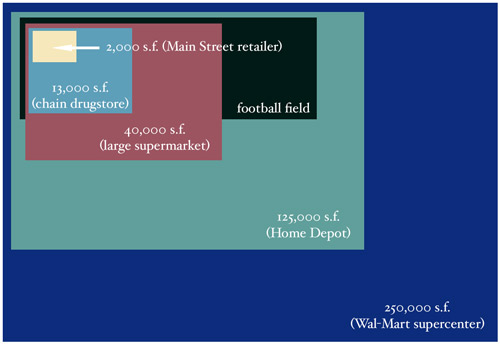
Supercenter has nothing to do with size
Sometimes size does matter.
A 121,000 sq ft WalMart Supercenter is the equivalent of 50 downtown independent stores.
Or, 12 Kinney's (a true regional company) Drug stores.
Or, 4 football fields.
Web Wars Escalate!
Wal-Mart supported Working Families for Wal-Mart (I am a card carrying member of WFFWM) is tired of being criticized by paid union leaders. It is every American's right to shop and buy stuff at one convenient location. You save money and time! Just try not to think about any possible peripheral effects of your actions.
In any case, Working Families for Wal-Mart must not be working very well. WFFWM has started up another website called 'paid critics'. This is a much better website than WFFWM in that it uses the tried and true 'Swiftboating' techniques designed by Karl Rove. In fact, 'paid critics' is actually run by paid critics, some who helped get us involved in the Iraq War, some who used to work for big tobacco and my favorite RedState blog founder and current Edelman PR employee Mike Krempasky (BTW, he is the least evil member of the group, but I voted for him).
To further escalate the Wal-Mart/Union war, we now have an entertaining site called 'a bunch of greedy right wing liars who work for Wal-Mart'. Seriously! You can even vote on who is the most evil greedy right winger (poor Mike is in 5th place, but I'm sure he's working on it when he's not playing poker or shooting pool).
One thing you can count on.....NO ONE at 'paid critics' comes from a 'working family'. These guys are out of work, ex-Republican party operatives doing what they do best. Does anyone believe these guys actually care about actual 'working families'?
We have paid Union members (from WakeUpWal-Mart) fighting $300 billion Wal-Mart, Inc. for living wages and benefits. Asking for fair labor practices. Asking that jobs not be shipped overseas. Then you have these guys:
Taylor 'don't count the votes' Gross,
Rick 'my house cost more than yours' Berman,
Kevin 'RNC' Sheridan,
Lee 'don't raise the minimum wage' Culpepper,
Mike 'I missed the recount riot' Krempasky,
Robert 'Tobbacco is Good For You' McAdam
and Terry 'I don't know Tom Delay' Nelson
These guys are being paid to swiftboat the people who are lobbying for a better life for actual 'working' people. These guys do not make $10 an hour.
By all means, visit 'paid critics' and get the Wal-Mart/Edelman viewpoint from a bunch of guys who you couldn't pay to set foot in a Wal-Mart store. Guy's that don't know the meaning of the word 'fair'. Then visit 'a bunch of greedy right wing liars who work for Wal-Mart' and find out what these guys have done in their past lives in the name of God, country and the almighty dollar.
UPDATE: See comments by Joe Trippi
Fratpack
Scatterbox
Writing on the Wal
In any case, Working Families for Wal-Mart must not be working very well. WFFWM has started up another website called 'paid critics'. This is a much better website than WFFWM in that it uses the tried and true 'Swiftboating' techniques designed by Karl Rove. In fact, 'paid critics' is actually run by paid critics, some who helped get us involved in the Iraq War, some who used to work for big tobacco and my favorite RedState blog founder and current Edelman PR employee Mike Krempasky (BTW, he is the least evil member of the group, but I voted for him).
To further escalate the Wal-Mart/Union war, we now have an entertaining site called 'a bunch of greedy right wing liars who work for Wal-Mart'. Seriously! You can even vote on who is the most evil greedy right winger (poor Mike is in 5th place, but I'm sure he's working on it when he's not playing poker or shooting pool).
One thing you can count on.....NO ONE at 'paid critics' comes from a 'working family'. These guys are out of work, ex-Republican party operatives doing what they do best. Does anyone believe these guys actually care about actual 'working families'?
We have paid Union members (from WakeUpWal-Mart) fighting $300 billion Wal-Mart, Inc. for living wages and benefits. Asking for fair labor practices. Asking that jobs not be shipped overseas. Then you have these guys:
Taylor 'don't count the votes' Gross,
Rick 'my house cost more than yours' Berman,
Kevin 'RNC' Sheridan,
Lee 'don't raise the minimum wage' Culpepper,
Mike 'I missed the recount riot' Krempasky,
Robert 'Tobbacco is Good For You' McAdam
and Terry 'I don't know Tom Delay' Nelson
These guys are being paid to swiftboat the people who are lobbying for a better life for actual 'working' people. These guys do not make $10 an hour.
By all means, visit 'paid critics' and get the Wal-Mart/Edelman viewpoint from a bunch of guys who you couldn't pay to set foot in a Wal-Mart store. Guy's that don't know the meaning of the word 'fair'. Then visit 'a bunch of greedy right wing liars who work for Wal-Mart' and find out what these guys have done in their past lives in the name of God, country and the almighty dollar.
UPDATE: See comments by Joe Trippi
Why does this blog look so much like a classic Swift-Boat attack? Probably because Wal-Mart has hired many of the same corporate and political operatives involved in past high-profile smear campaigns. Kevin Sheridan, a former spokesman and operative at the RNC, now works for Wal-Mart as consultant from Edelman PR. Terry Nelson, previously a Deputy Chief of Staff for the RNC and National Political Director for the Bush/Cheney 2004 campaign, is currently a strategy advisor for Working Families for Wal-Mart - the group officially behind paidcritics.com and fully funded by Wal-Mart. And then there’s Rick Berman and Bob McAdam, two men who worked hard for Big Tobacco to convince Americans that smoking is good for you. Now they work for or with Wal-Mart on its communications strategy.Additional comments:
Fratpack
Scatterbox
Writing on the Wal
Tuesday, July 18, 2006
Sam Says:
“We still want to drive a hard bargain, but now we need to guard against abusing our power.” - Sam WaltonMaybe Wal-Mart abusing it's power is just a matter of opinion. But, I'm guessing many of those American factory employee's that are out of work might disagree. Is there any other way that Wal-Mart abuses it's power?
Monday, July 17, 2006
Wal-Mart's Pay Gap
Want to see how much Wal-Mart excutives make in comparison to overseas workers? Lookhere.
Wal-Mart claims it doesn't make enough money to pay it's workers better. But wouldn't it's 1.3 million employee's in the USA be able to purchase more 'stuff' from Wal-Mart if they were better paid? It worked for Henry Ford.
These Wal-Mart exec's are the 'rich outsiders'.
Wal-Mart claims it doesn't make enough money to pay it's workers better. But wouldn't it's 1.3 million employee's in the USA be able to purchase more 'stuff' from Wal-Mart if they were better paid? It worked for Henry Ford.
These Wal-Mart exec's are the 'rich outsiders'.
Sam says:
“Maybe the most important way in which we at Wal-Mart believe in giving something back is through our commitment to using the power of this enormous enterprise as a force for change.” - Sam Walton
How come Wal-Mart founder Sam Walton thought Wal-Mart could be a force for change yet current Wal-Mart supporters don't believe Wal-Mart has any power/responsibility for change? Any ideas on how Wal-Mart could use their enormous enterprise to institute change?
Saturday, July 15, 2006
Wal-Mart Gives the Small Shoplifter a Break
Wal-Mart's new shoplifting policy will give the 'little guy' (someone who steals less than $25 worth of merchandise) a break. Read about it HERE.
This helps Wal-Mart because it's not really worth prosecuting the 'little guy' even though Sam Walton wanted every shoplifter prosecuted.
Maybe the SL Village Board or Village Manager should give Chief Zofchak a phone call and find out about his experiences with Wal-Mart and what it's cost his police department.
This helps Wal-Mart because it's not really worth prosecuting the 'little guy' even though Sam Walton wanted every shoplifter prosecuted.
J. P. Suarez, who is in charge of asset protection at Wal-Mart, said it was no longer efficient to prosecute petty shoplifters. “If I have somebody being paid $12 an hour processing a $5 theft, I have just lost money,” he said. “I have also lost the time to catch somebody stealing $100 or an organized group stealing $3,000.”It will also help small town police departments. Would Saranac Lake need to hire another police officer just to cover a Wal-Mart Supercenter?
It may also serve to placate small-town police departments across the country who have protested what the company has called its zero-tolerance policy on shoplifting. Employees summoned officers whether a customer stole a $5 toy or a $5,000 television set — anything over $3, the company said.
At some of the chain’s giant 24-hour stores, the police make up to six arrests a day prompting a handful of departments to hire an additional officer just to deal with the extra workload.
"I had one guy tied up at Wal-Mart every day,” said Don Zofchak, chief of police in South Strabane Township, Pa., which has 9,000 residents and 16 officers. He said the higher threshold for prosecution “would help every community to deal with this.”
Maybe the SL Village Board or Village Manager should give Chief Zofchak a phone call and find out about his experiences with Wal-Mart and what it's cost his police department.
Friday, July 14, 2006
Wal-Mart YES or Wal-Mart NO Signs
Call Wal-Mart and they will send you a cool free "WalMart Yes" sign for your lawn. You can also get them if you don't support WalMart and the Yes is easy enough to change to anything else you want it to say. But it's almost not worth it. Looking within the Saranac Lake Village limits, the French Hill area, the Lake St/Petrova area, the Baker St/Lower Park Av. area and the Shepard/Franklin Av. areas you only see pockets of these signs. I was expecting to see at least 20% of the lawns sporting "WalMart Yes" signs but I doubt it's even 10%. This isn't too surprising. If WalMart supporters were a majority within the SL Village limits, Tom Michael wouldn't be mayor nor would be have two new Democrat trustees.
Now the Save Saranac Lake Coalition is also going to make signs. They are having a sign making get-together this Sunday, July 16th from 6PM to 9PM in the park in Gabrial's. Your kids are invited also as there is a playground in the park. Bring plywood, paint, brushes, tools etc although there will be extra material there.
SSLC points out:
Now the Save Saranac Lake Coalition is also going to make signs. They are having a sign making get-together this Sunday, July 16th from 6PM to 9PM in the park in Gabrial's. Your kids are invited also as there is a playground in the park. Bring plywood, paint, brushes, tools etc although there will be extra material there.
SSLC points out:
We know that a battle of the signs can get ugly. But, please remember, IF Wal-Mart gets in, the ugliness is here to stay...........signs are temporary.It will be interesting to see what slogans appear on these signs.
Thursday, July 13, 2006
Wal-Mart, the Government and TOTT
A caller this morning on TOTT pointed out "It's not Wal-Mart's fault U.S. manufacturing jobs are going overseas, it's the Federal Government. Definitely true because the Federal Government gave China 'most favored nation status' among passing many other 'business friendly' trade laws. However, as many people understand, our congress does not pass laws independent of money and lobbyists. Look at this article from the Washington Post.
And it's not just Republicans:
And it's not just WalMart, Inc., it's also the Waltons:
And this:
You can go here to see how much WalMart and the Waltons pay Patton Boggs, LLP to lobby on their behalf.
Wal-Mart, the retailer many experts consider the most-sued company in America, stands to benefit from the new class-action law, which is designed to cut down on lawsuits and big verdicts by steering some cases into federal courts, away from state courts with track records of siding with plaintiffs and awarding multimillion-dollar verdicts, according to policy experts.
The company, which expressed disdain for Washington politics in the 1990s, changed its tune dramatically after then-Senate Majority Leader Trent Lott (R-Miss.) sat down with the company's managers in Bentonville, Ark., in the late 1990s and warned them of the perils of sitting on the sidelines.
Soon after, Wal-Mart became a major player in GOP politics, funneling money to groups such as the U.S. Chamber to lobby on its behalf and creating a political action committee. In the elections last year, the company's $2.4 million PAC was the third-largest corporate PAC in the country, with nearly 80 percent of its money going to Republicans. Wal-Mart officials contributed more than $30,000 to Bush last election, according to Federal Election Commission data compiled by the Center for Responsive Politics, a nonpartisan organization that prepared the fundraising data for this article.
In many cases, companies such as Wal-Mart spend significantly more money hiring Republican lobbyists and helping fund groups such as the U.S. Chamber and other GOP-dominated trade associations that are not required to disclose their donors than they devote to political candidates. Wal-Mart, for instance, has contributed at least $1 million to the Chamber of Commerce, according to chamber documents.
Marty Heires, a Wal-Mart spokesman, said the company did not want to comment for this report. "They want to play it low-key on this," he said.
And it's not just Republicans:
The Clintons also benefited financially from Wal-Mart. Hillary Clinton was paid $18,000 each year she served on the board, plus $1,500 for each meeting she attended. By 1993 she had accumulated at least $100,000 in Wal-Mart stock, according to Bill Clinton's federal financial disclosure that year. The Clintons also flew for free on Wal-Mart corporate planes 14 times in 1990 and 1991 in preparation for Bill Clinton's 1992 presidential bid.
And it's not just WalMart, Inc., it's also the Waltons:
Wal-Mart (WMT) drew broad scrutiny last year as its political spending soared in nationwide battles over health care, labor and other hot-button issues threatening the giant retailer's growth.
The late Sam Walton, founder of retail giant Wal-Mart.
AP file
Now, in a little-noticed move, the company's founding family has plunged into a fight to pass income tax changes and other legislation that could preserve its grip on the USA's biggest business and the family's $84 billion fortune.
Led by Sam Walton's only daughter, Alice, the family spent $3.2 million on lobbying, conservative causes and candidates for last year's federal elections. That's more than double what it spent in the previous two elections combined, public documents show.
And this:
Noble says the Bush administration monitors gifts to groups such as Progress for America, so the Walton donation puts the family on the White House speed dial.Go here for more on the Waltons lobbying activities.
You can go here to see how much WalMart and the Waltons pay Patton Boggs, LLP to lobby on their behalf.
Wednesday, July 12, 2006
Wal-Mart and China and TOTT
This morning a Wal-Mart critic called TOTT and pointed out that 28 cents out of every dollar spent at Wal-Mart goes to China, a communist country. Four callers were obviously ready at the phones to point out the error-of-his-ways of this poor Wal-Mart critic. I don't know if the 28 cent figure is correct or not, but the Wal-Mart critic certainly had a point. He just didn't take it to the next step.
Wal-Mart supporters will immediately scream "but everybody sells Chinese made products". That's true. But most everybody doesn't have a choice but to sell Chinese or other foreign-made consumer goods. Wal-Mart is one of the major reasons that so many retail goods are now made overseas. Wal-Mart forces it's suppliers to cut prices to the bone such that they eventually have no choice but to go overseas. One example out of many, many, many.
Wal-Mart supporters will immediately scream "but everybody sells Chinese made products". That's true. But most everybody doesn't have a choice but to sell Chinese or other foreign-made consumer goods. Wal-Mart is one of the major reasons that so many retail goods are now made overseas. Wal-Mart forces it's suppliers to cut prices to the bone such that they eventually have no choice but to go overseas. One example out of many, many, many.
Take the L.R. Nelson lawn sprinklers, which used to be made in Peoria, Ill., before Wal-Mart pressured Nelson to make them in China instead. Before the move, one laid-off Peoria worker told the reporter, Chinese managers were "walking around the plant and videotaping us working. That was horrible, horrendous. Right in our faces. They are taking our jobs." More HERE and HERE.I can understand people wanting good bargains and thus supporting Wal-Mart. I don't understand the blind, uneducated support however. You want cheap prices and you don't care what Wal-Mart is doing to our country (and the World), fine. But at least make an attempt to understand exactly what you are supporting. After all, it's not your job that's being exported overseas. Yet. Remember, you can't buy all that stuff you want if you don't have a job.
Tuesday, July 11, 2006

Village Board Meeting - July 10 (and a rant)
Yes I attended the Village Board Meeting last night. The topic of rezoning the village sandpit area came up after 2.5 hrs of unrelenting and uninteresting reports, discussion and repartee (ok so there wasn't really any repartee). There is an article in todays ADE and at the WNBZ news site concerning the rezoning discussion. Here is what I took home.
It's not really clear to me where the Village is in the SEQR process. If a positive declaration has been made, a draft environmental impact statement must be prepared and made available to the public. 'Scoping', a process that identifies topics the EIS should include is recommended but not required. If scoping is done, there is a requirement for community participation. After a 30 day public comment period on the draft EIS, a public hearing may be held. "All substantive comments become part of the permanent record and must be responded to by the lead agency in the final EIS. The DEC suggests that the lead agency disregard speculative comments and statements that cannot be supported. Read a two page summary of the SEQR process here.
Trustees Olsen and McEneany want to continue the SEQR process and go for a vote to rezone the sandpit area. The problem is that the public hearing is meant to discuss the various impacts the rezone will have on the community and environment. No one knows what the impacts will be without expert consultation, so how can you discuss them?
I can guess what some of the speculative comments will be already because we hear them everyday:
Wal-Mart won't hurt the environment. Yes they will and have done so. Many times. Many times.
Wal-Mart will increase the number of good jobs in the area. This and this study claims otherwise. Oh yeah, while you are at it read this too. They also seem to have a small problem with their female employees. Oh yeah, and don't gripe when they don't pay you for the hours you work.
Wal-Mart will bring in new business to the area. Sorry, this as well as this study says that is unlikely.
Wal-Mart will donate lot's of money to our community. Read this about Wal-Mart Philanthropy. And more here.
Wal-Mart will have no effect on social programs. Wrong again. Read this.
Wal-Mart will bring in badly needed tax revenues. Maybe, but read this first. Better think about increased law enforcement costs while you are at it.
No, none of the above suggested readings address Saranac Lake specifically. But they are a lot better than the truthiness speculation that you hear every day from Wal-Mart supporters.
On the other hand, you don't work there, and you didn't ship the manufacturing jobs overseas, and you weren't responsible for the low wage jobs. Nope, you just spend your money there and provide Wal-Mart with the incentive to continue doing business their way. But "Wal-Mart helps poor people"! That's one way to look at it I guess, but I think "Wal-Mart sells to poor people is much more accurate. And, the more poor people there are, the better Wal-Mart does.
It's not really clear to me where the Village is in the SEQR process. If a positive declaration has been made, a draft environmental impact statement must be prepared and made available to the public. 'Scoping', a process that identifies topics the EIS should include is recommended but not required. If scoping is done, there is a requirement for community participation. After a 30 day public comment period on the draft EIS, a public hearing may be held. "All substantive comments become part of the permanent record and must be responded to by the lead agency in the final EIS. The DEC suggests that the lead agency disregard speculative comments and statements that cannot be supported. Read a two page summary of the SEQR process here.
Trustees Olsen and McEneany want to continue the SEQR process and go for a vote to rezone the sandpit area. The problem is that the public hearing is meant to discuss the various impacts the rezone will have on the community and environment. No one knows what the impacts will be without expert consultation, so how can you discuss them?
I can guess what some of the speculative comments will be already because we hear them everyday:
Wal-Mart won't hurt the environment. Yes they will and have done so. Many times. Many times.
Wal-Mart will increase the number of good jobs in the area. This and this study claims otherwise. Oh yeah, while you are at it read this too. They also seem to have a small problem with their female employees. Oh yeah, and don't gripe when they don't pay you for the hours you work.
Wal-Mart will bring in new business to the area. Sorry, this as well as this study says that is unlikely.
Wal-Mart will donate lot's of money to our community. Read this about Wal-Mart Philanthropy. And more here.
Wal-Mart will have no effect on social programs. Wrong again. Read this.
Wal-Mart will bring in badly needed tax revenues. Maybe, but read this first. Better think about increased law enforcement costs while you are at it.
No, none of the above suggested readings address Saranac Lake specifically. But they are a lot better than the truthiness speculation that you hear every day from Wal-Mart supporters.
On the other hand, you don't work there, and you didn't ship the manufacturing jobs overseas, and you weren't responsible for the low wage jobs. Nope, you just spend your money there and provide Wal-Mart with the incentive to continue doing business their way. But "Wal-Mart helps poor people"! That's one way to look at it I guess, but I think "Wal-Mart sells to poor people is much more accurate. And, the more poor people there are, the better Wal-Mart does.
NLRB Helps Wal-Mart Remain Union Free

Kevin Drum at Washington Monthly has some interesting observations about the decline of unions in the United States and its effects on wages.
Successive NLRB rulings, however, have steadily chipped away at labor rights and helped companies like Wal-Mart remain happily union free. That's good for big corporations who contribute to the Republican Party, but not so good for middle class workers who no longer have anyone to fight for pay raises and better working conditions. The result is the three-decade wage stagnation illustrated in the chart above.No more well paying, secure manufacturing jobs in the USA, so no more Unions either. But there are plenty of 'good' jobs at Wal-Mart. Wal-Mart supporters will argue that Union mediated high salaries drove manufacturers out of business and this is just a result of free trade. However, anyone that has done even a bit of reading will realize there is no such thing as free trade or we wouldn't have a Federal Trade Commission or National Labor Relations Board. Many manufacturers had little choice in the matter of exporting jobs overseas. Wal-Mart all but required that they do so. Charles Fishman explains it all in "The Wal-Mart Effect". Of course no one expects a rabid Wal-Mart supporter to read such a book because they automatically assume it was written by a "Wal-Mart hater". Nothing could be further from the truth. Fishman is a reporter and he tried to get Wal-Mart and it's suppliers to provide input into the book. Obviously they were not interested.
Monday, July 10, 2006
Carl E. Person
"I'm surprised that the thousands of reporters dealing with Wal-Mart and its staggering growth never (and I repeat never)explain that Wal-Mart could not survive in business if its paid the same per-unit price for its inventory that its competitors pay. By obtaining lower per-unit prices (in alleged violation of the Robinson-Patman Act, which prohibits price discrimination), Wal-Mart is able to maintain lower retail prices and drive its competitors out of business. This is not "efficiency", but a failure of the government to enforce the antitrust statute designed to prohibit the evils resulting from this kind of prohibited business conduct".
Mr. Person is a Harvard trained antitrust attorney who wrote a book called SAVING MAIN STREET AND ITS RETAILERS. His website has quite a bit of advice on how to fight Wal-Mart.
APPENDIX C – Representations and Warranties Which a Community Should Require a Major Retailer to Sign as a Condition to Obtaining Requested Approval(s).Here he lists a number of interrogatories that a village or town board should require when dealing with a major retailer.
you might ask for a description of the controls to ensure that the applicant is not purchasing its goods at discriminatory or, worse, below-cost prices in violation of the Robinson-Patman Act or Sherman Act. The Sarbanes-Oxley Act (2002) requires each public corporation to have an Audit Committee made up of independent individuals which committee makes sure the corporation is in compliance with various laws (where the violation of which could be materially adverse to the company’s financial interests), including the Robinson-Patman Act. It seems clear to me that none of the major retailers will be able to pass an audit of the issue of whether the manufacturers are selling to the major retailer at discriminatory, unlawful prices, and at prices which are below the manufacturers’ direct cost.
The Antitrust Case Against Wal-Mart
Breaking the Chain by Barry C. Lynn is the title of an article published in this months Harper's Magazine. You can read it at the Saranac Lake Free Library. It's a difficult article to read because although it makes a case for antitrust action against Wal-Mart it also makes you realized that it's not going to happen in the near future. The reason? One word - politics. Ever since Saint Reagan was president the concept of antitrust lawsuits by the government has basically been thrown out the window. To Reagan, "only one action could be regarded as truly unacceptable - to gouge the consumer"(B.C. Lynn, Harpers, July 2006).
Well what about the Robinson-Patman Act of 1936, also known as the Anti-Price Discrimination Act or the "Anti-A&P Act? Wright Patman, the Texas Democrat who was the main force behind the bill, made sure everyone understood Congress's intent. "The express purpose of the Act is to protect the independent merchant" B.C. Lynn, Harpers, July 2006).
See the Great Atlantic & Pacific Tea Company was putting small family owned grocery stores out of business. They did this by undercutting them in their pricing. Back in the day, the US Federal Government was relentless against the A&P, hauling them repeatedly into court. The A&P was also a monopsony. This is when a company has the power to dictate pricing to its suppliers (remind you of anyone?).
There is another older article by Robert Reich entitled "Wal-Mart is too big: But not according to America's antitrust laws".
Well what about the Robinson-Patman Act of 1936, also known as the Anti-Price Discrimination Act or the "Anti-A&P Act? Wright Patman, the Texas Democrat who was the main force behind the bill, made sure everyone understood Congress's intent. "The express purpose of the Act is to protect the independent merchant" B.C. Lynn, Harpers, July 2006).
See the Great Atlantic & Pacific Tea Company was putting small family owned grocery stores out of business. They did this by undercutting them in their pricing. Back in the day, the US Federal Government was relentless against the A&P, hauling them repeatedly into court. The A&P was also a monopsony. This is when a company has the power to dictate pricing to its suppliers (remind you of anyone?).
There is another older article by Robert Reich entitled "Wal-Mart is too big: But not according to America's antitrust laws".
Is Wal-Mart too big? Not according to America's antitrust laws, which consider only one thing - whether a company is so big it drives competitors out, thereby forcing consumers to pay more. Wal-Mart is huge but it still represents only 8 percent of retail sales in America. That's not nearly enough to reduce competition.Nope, you probably need to control 30% of the market before the government will take notice. But Reich tells us that antitrust laws had another purpose that might give us hope:
Yet there's another tradition of American antitrust that may be relevant here. We don't hear much about it any longer, but a century ago antitrust was also concerned about companies becoming so large they distorted the political process. In fact, the danger to democracy posed by large corporations was the primary reason for antitrust laws being enacted in the first place.Indeed, even at the local level you can see Wal-Mart spending money to influence the political process. But I don't hold out much hope for antitrust actions on political grounds either. Republicans just aren't interested in regulating big corporations anymore and one has to wonder about Democrats as well. After all, our own Senator Hillary Clinton once served on Wal-Mart's Board of Directors. Maybe someday Wal-Mart supporters and corrupt politicians will wake up and see the effects of Wal-Mart not just on our own economy, but the entire world's economy. The question then is will it be soon enough to do something about it.
Sunday, July 09, 2006
Mia Masten: Wal-Mart Eastern Region Liar-in-Chief?

Have you seen this woman around? This is Mia Masten and she works for Wal-Mart. The press gives her several 'titles' but she seems to be the Eastern Region Community Relations person (at least as of 2005). Ms. Masten is a former Clinton administration staffer (her post was special assistant to the senior adviser to the president for policy development). From some of the quotes attributed to her it seems her job at Wal-Mart may be Liar-in-Chief for the East Coast. This is the 'outsider' (or someone just like her)whose job it is to convince Saranac Lakers that their future is dependent on a Wal-Mart store. I bet you anything she makes more than $10.40 an hour (the average Wal-Mart wage, how about telling us the median Wal-Mart wage?).
"I think most reasonable people would say zoning will probably be more difficult in 5 years or 10 years than it is today," he said in a presentation to analysts. "And so every store we get today over what we normally would have planned might be the store that would have really been delayed in the future as zoning got tougher and tougher." H. Lee ScottThat's right. Build now, even if the store is a business risk, because it's only going to be harder to build in the future. To get these stores built in communities that don't want them, sometimes you need to bring in the liar-in-chief, Mia Masten.
"As these big-box bills come up, all retailers will just have to be flexible," she said. "In this case, we developed a model that allowed us to reach our customers."Mia Masten, Wal-Mart Eastern Region Community RelationsThis quote was in response to Wal-Mart's idea of building two 75,000 sq ft stores next to each other in Dunkirk, MD to get around zoning regulations.
Masten responded to Salzman. "We don't force people to work overtime. It's not unusual to have 1,000 people apply for 300 jobs, so we must be doing something right," she said as the room erupted with deafening cheers and applause. Masten at a Wal-Mart supporter meeting in St. Albans, VTOf course, Wal-Mart workers in Massachusetts disagree with Ms. Masten. This is a lie from almost everything I've read. I guess we will see if the MA courts agree.
Mia Masten, a spokeswoman for Wal-Mart, told the Times that Wal-Mart often tries to work with communities and is not "just coming in and bulldozing our way in."Here
This is just pure, unadulturated bullshit. Dare I even say a lie?
''I hope we'll be given a fair chance,'' said the Wal- Mart spokeswoman, Mia Masten, corporate affairs director for the eastern region. ''We are interested in New York City.Yes, Wal-Mart only wants a "fair chance", you know they are a company that truly believes in fair play.
"It sounds as if we're trying to go and push our way in," Masten said. "But we are asking for and getting local input. We want a project that everyone likes at the end of the day."HereHow does Ms. Masten define "everyone"?
Friday, July 07, 2006
"Say Yes to Wal-Mart" Campaign Has Begun
If you are a wealthy, transplant living and paying taxes in the Saranac Lake area please BUTT OUT on the Wal-Mart issue.
However, and this is very important, if you are the Wal-Mart Eastern Region Community Relations people (TRUE OUTSIDERS) please feel welcome to tear our community apart.
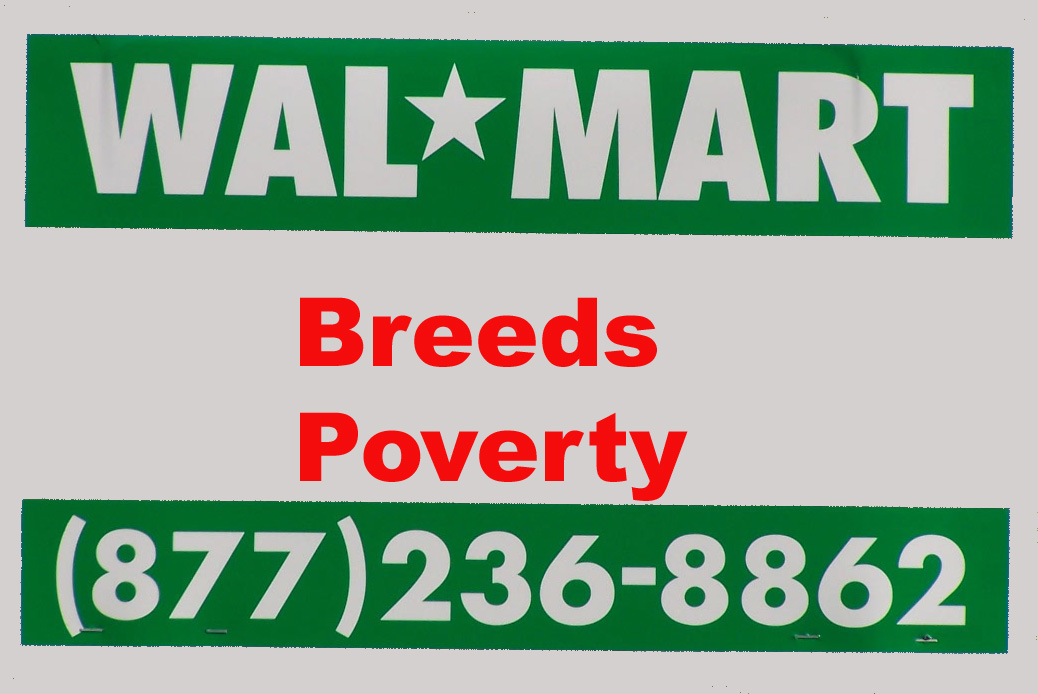
Soon you will be seeing "Say Yes to Wal-Mart" signs sprouting up around the area, courtesy of this office. Don't believe me? Call 877-236-8862 and listen to the message. You can tell them how many signs you want them to send you. I support the right of CARD people to lobby in support of a Wal-Mart store, they are local area residents at least. But even CARD should be outraged at a group of professional, paid, outside Wal-Mart supporters meddling in our community affairs.
This is so OUTRAGEOUS. I suggest we all call and order hundreds of free signs courtesy of Wal-Mart. It will be a simple matter to change the YES to a NO. After you get your free order of signs, call again and tell them how outraged you are.
This is a perfect example of Wal-Mart 'Community Relations'.
UPDATE: I noticed there was a visit or two from Edelman PR this afternoon. Probably wanting to see the reaction to Wal-Mart's latest shenanigans. After reading Fishman's book I was beginning to believe that Wal-Mart was just clueless, not really evil. But damn, they are one truly evil company.
However, and this is very important, if you are the Wal-Mart Eastern Region Community Relations people (TRUE OUTSIDERS) please feel welcome to tear our community apart.
Soon you will be seeing "Say Yes to Wal-Mart" signs sprouting up around the area, courtesy of this office. Don't believe me? Call 877-236-8862 and listen to the message. You can tell them how many signs you want them to send you. I support the right of CARD people to lobby in support of a Wal-Mart store, they are local area residents at least. But even CARD should be outraged at a group of professional, paid, outside Wal-Mart supporters meddling in our community affairs.
This is so OUTRAGEOUS. I suggest we all call and order hundreds of free signs courtesy of Wal-Mart. It will be a simple matter to change the YES to a NO. After you get your free order of signs, call again and tell them how outraged you are.
This is a perfect example of Wal-Mart 'Community Relations'.
UPDATE: I noticed there was a visit or two from Edelman PR this afternoon. Probably wanting to see the reaction to Wal-Mart's latest shenanigans. After reading Fishman's book I was beginning to believe that Wal-Mart was just clueless, not really evil. But damn, they are one truly evil company.
A Few More Questions From Fishman
Even if you are the most devoted fan of Wal-Mart, maybe you could think even a little bit about these questions.
Wal-Mart is now so big that it's possible to ask a whole set of questions that would have been irrelevant, if not downright silly, twenty years ago.I think the Village Board of Trustees has an obligation to ask some of these questions also. They owe it to the Village of Saranac Lake and it's residents who voted them into office.
What is the impact of Wal-Mart's wages not on its own workers, but on the wages in an entire town, or in an entire industry?
What is Wal-Mart's impact on the variety and availability of consumer goods?
What is Wal-Mart's direct impact on sending U.S. manufacturing jobs overseas?
What is the impact on local economies of Wal-Mart's abandoning old stores, and even as Wal-Mart freely announces precise numbers for stores it opens, how many stores does it close but leave empty?
What is Wal-Mart's impact on the environment?
What is the impact of Wal-Mart's suppliers on the environment?
...as a country, we have the right to ask the questions; we have the power to ask the questions; indeed we have the responsibility to ask the questions.
The Wal-Mart Effect by Charles Fishman - 4
Wal-Mart could be more like Southwest Airlines.
Southwest Airlines isn't just cheap, it's fun. Wal-Mart isn't just cheap, it's joyless, when not downright vexing. Wal-Mart takes its duty to lower prices so seriously, there's no room for any other attitude, for them or us, except duty. Even without doubts about wages, suppliers, local businesses, American jobs, and quality, Wal-Mart has done such a superb job of austerity from start to finish that austerity is all that's left.Fishman asks some very important questions about Wal-Mart:
Do we value cheap merchandise more than good factory jobs?An insight into Wal-Mart corporate behavior:
Do we value the convenience of buying everything from eggs and eyeglasses, Levi's and lawm mowers in a single place more than charming main streets with local shopkeepers?
Do we value the freedoms of a business to decide where and how to serve its customers more than the responsibility of a local government to safeguard the shape and character of a town?
In a democracy, do we want a single company to have the reach and power that Wal-Mart has - a power that right now is accountable to no one?
Do we value the "rules" of economic fair play as they happen to be written right now more than our ability to recognize and manage a totally new kind of economic power?
The source of almost all of Wal-Mart's troubles can be traced not to some evil conspiracy spun out of the home office, but to the slogan printed right on every Wal-Mart bag: "Always low prices. Always." The second always is in italics and underlined, just so there is no confusion about the mission.
It is remarkable that almost all of Wal-Mart's behavior - even the bad behavior or the seemingly diabolical behavior - can be explained by taking Wal-Mart at its word. It really is all about "always low prices."
The Wal-Mart Effect by Charles Fishman - 3
That Wal-Mart has driven jobs overseas is an understatement.
And what about those overseas jobs and factories?
To survive n the face of the sort of pricing demands Wal-Mart made of Vlasic, Huffy, Lovable, and Levi Strauss, some consumer products companies have had to lay off employees and close U.S. plants in favor of outsourcing products overseas.In the 1980's I clearly remember Wal-Mart being proud that they sold 'American-made' items. It was a major part of their marketing. Forward to 2004: Wal-Mart now imports 18 billion dollars worth of Chinese-made goods.
"People say, how can it be bad for things to come into the United States cheaply? How can it be bad to have a bargain at Wal-Mart?Simple really, you need a job that pays a living wage to buy stuff.
And what about those overseas jobs and factories?
The problem isn't callous, greedy, and inhumane factory managers. "Wal-Mart is itself the reason for the inhumane conditions," the suit alleges. "It uses its vast market power to insist on low unit prices that are possible only if workers are squeezed to such an extreme degree that they can barely survive the long hours and low wages they are forced to endure."But Wal-Mart will tell you that they have ethical standards for overseas manufacturers and that they inspect the factories of Wal-Mart suppliers. That is true. But:
Yes, the factory inspections team did 12,500 inspections, but only 8 percent of them were surprise inspections.In 2004, 8,900 out of 11,500 scheduled inspections of overseas factories revealed serious violations in factories that knew in advance that Wal-Mart inspectors were coming.
Thursday, July 06, 2006
Wal-Mart Rolls Back Pay
Wal-Mart is in a bit of trouble in Massachusetts. A class-action lawsuit claims that Wal-Mart skimped "on work breaks and pay owed to thousands of former employees" to the tune of over 1 million times.
Of course:
Of course:
Wal-Mart declined to address the allegations in the case, saying, “It is disrespectful to the court to comment on matters that will be heard in a legal proceeding. . . . we’re not going to comment.”Wal-Mart has 70 lawsuits throughout the country claiming similiar allegations. People love to talk about how well Wal-Mart treats disabled employees.
Among his clients is a disabled woman from Chelmsford who has accused Wal-Mart of changing her time sheet to show she worked only one minute on days she worked eight-hour shifts. Except in this instance below.And Wal-Mart marches cluelessly onward.
“When I went to to complain, my manager just told me (my paycheck) was right, that there wasn’t a problem,” said Kelly Thompson, 32, who worked as a greeter for about a year before being terminated. “But they would never open up the books to show me. They just insisted.”
Thompson, who has multiple sclerosis and uses a wheelchair, said she was shocked when her lawyers showed her a computer analysis alleging that Wal-Mart routinely denied her pay for the hours she worked. “I feel like I was ripped off,” she said. “I couldn’t believe they would actually do this to someone.”
Tuesday, July 04, 2006
Wal-Mart Supports Unions!
www.unionizewalmart.com. Is it owned by a leftist group that wants to unionize Wal-Mart stores? Nope. It's owned by Registrant:
Wal-Mart Stores, Inc.
805 Moberly Ln M31
Bentonville, AR 72716-0560
US
So, Wal-Mart either wants to help unionize its stores or they want to keep unions from using that domain name. Unfortunately, they forgot to buy unionizewalmart.ws
Wal-Mart Stores, Inc.
805 Moberly Ln M31
Bentonville, AR 72716-0560
US
So, Wal-Mart either wants to help unionize its stores or they want to keep unions from using that domain name. Unfortunately, they forgot to buy unionizewalmart.ws
Sunday, July 02, 2006
The Wal-Mart Effect by Charles Fishman - 2
Jobs and Manufacturing
Rural Effects
Stone updated his study in 1993.
While Wal-Mart was adding 480,000 jobs between 1997 and 2004, US manufacturing jobs during those years fell by 3,100,000 jobs, a loss of 37,000 factory jobs a month, on average, for eighty-four straight months.K-Mart and Target and Sears etc. also sell clothing made overseas is commonly pointed out by Wal-Mart supporters. Yeah, they do. But who shipped the jobs overseas. That would be the largest company on earth wouldn't it?
...during the last 7 years, a remarkable milestone has passed all but unnoticed: In 2003, for the first time in modern US history, the number of Americans working in retail (14.9 million) was greater than the number of Americans working in factories (14.5 million). We have more people working in stores than we do making the merchandise to put in them. .....Just ask the residents of Peoria, who used to make lawn sprinklers for L.R. Nelson.
Rural Effects
In towns with a Wal-Mart, sales of general merchandise leaped dramatically compared to the state average, up 55% per capita after three years. In the 45 small towns within twenty miles of a Wal-Mart, total sales dropped 13% after 3 years, nearly double the decline for similar Iowa towns that weren't near a Wal-Mart.The entire report of Wal-Mart's effect on rural communities by Dr. Ken Stone can be found under the links to the left.
But even in towns with Wal-Mart stores driving dramatic increases in the retail trade, there were losers. Grocery stores lost 5% of their sales after 3 years; specialty stores - drugstores, clothing stores, toy stores, and the like lost 12% of their sales after 3 years. Even service businesses in Wal-Mart towns lost business - down 13% after 3 years.
Stone updated his study in 1993.
Across the rest of the retail landscape, the arrival of Wal-Mart coincided with a swath of destruction. Grocery stores lost 5% of their business after 5 years; specialty stores lost 14% of their business, and clothing stores lost 18% of their business - all while total sales were rising 6%, mostly due to Wal-Mart.
In towns that were nearby but didn't have a Wal-Mart, Wal-Mart vacuumed customers away: clothing stores lost 13% of their business after 5 years; specialty stores lost 21%.
...small Iowa towns, with populations between five hundred and one thousand, lost 47% of their retail sales....
...43% of all stores selling men's and boy's clothing went out of business. Neary half of an entire retail category in a state was wiped out.
The Wal-Mart Effect by Charles Fishman
A few of my favorite parts of the book:
Concerning pharmacies
Monopoly and Monopsony
Concerning pharmacies
He opened a pharmacy at the Wal-Mart in Mena, Arkansas, #67, in 1982 or 1983. "There was already a pharmacy in the shopping center there. I opened with a coupon in the newspaper for $5 or $10 off, with the grand opening of our pharmacy, and the 9-cent rubbing alcohol special or something." The next day, the pharmacist in the shopping center announced that he would match Arch's coupon. "So the day after that, I ran a coupon for $20 off your next prescription. And I never heard another word from the guy after that."Not just competition, cut-throat, purposeful put-them-out-of-business competition.
You really can walk in the store, drop off your prescription, do your shopping, and pick up the prescription on the way out. "Once, Mr. Sam said to me, 'Clarence, tell those pharmacists to slow down a bit, so we can get the carts filled up some more.'" (pg. 43
Monopoly and Monopsony
The term for suppliers who are big enough to control prices and markets is familiar - that's monopoly, and anyone who has played the board game understands that if you control the available real estate, you get to charge not what the market will bear, but what you want.So it is pretty clear (at least to me) that Wal-Mart has a huge, and unfair, advantage over just about any other retail business in the USA. If you haven't read the 'Vlasic Pickle Story' you can fined it here.
There is a parallel economic concept for a company that is such a large buyer (Wal-Mart)- of pickles, say - that it holds an equivalent kind of price-control power. The term is monopsony
Saturday, July 01, 2006
A Meeting with H. Lee Scott
I ask Lee to describe the legacy he wants to be remembered for at Wal-Mart. He struggles with the question, falls back on the Sam Walton story, and describes himself as continuing a tradition rather then designing a new purpose for the giant company. Pressing him again for a better answer, he talks about the team
he wants to build and leave behind when he “turns out the lights in the office for the last time.” In effect, he keeps saying it’s not about him.
Pressed again, at this point a little uncomfortably, he talks about being the best they can be, about diversity programs, environmental initiatives, the careers they help their associates build. But nothing that feels like a clear purpose or focused direction.
I take a different tact. I admit that I, like hundreds of other critics, have my own perspective on what Wal-Mart is doing right (not much) and wrong (a lot) when it comes to corporate responsibility. On how to proactively manage the endless bad press they get. How they could go about seizing their potential. Did they want to hear my thoughts? Why not, they answer. Everyone else comes down here and tells us what they think we should do. We’re used to it at this point.
This is written by someone from Seventh Generation. Seventh Generation is a precept of the Great Law of the Haudenosaunee (Six Nations Iroquois Confederacy), which requires that chiefs consider the impact of their decisions on the seventh generation. Read it all here.
Friday, June 30, 2006
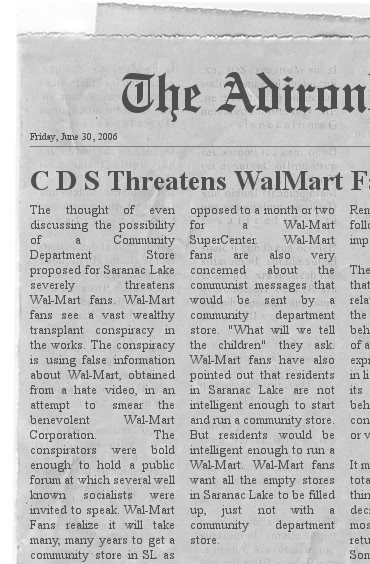
Revenge of the Wal-Mart Voters
Interesting politcal/Wal-Mart article by Ryan Sager on realclearpolitics.org (a conservative political website)
Go you fickle Wal-Mart shoppers!
What's Wal-Mart got to do with anything? Not a whole lot, except as a symbol of a particular type of voter: largely Southern, rural, lower-middle-class, female, socially conservative -- not big fans of tax cuts, but huge fans of government programs.
Zogby finds that while 85 percent of frequent Wal-Mart shoppers voted for President Bush's reelection in 2004 (and 88 percent of people who never shop there voted for Sen. John Kerry), Wal-Mart voters have turned on the president dramatically. In a poll taken earlier this month, they gave Bush a 35 percent approval rating -- compared to a 45 percent positive rating from born-again Christians, 49 percent from NASCAR fans, and 54 percent from self-identified conservatives.
The correlation between cheap underwear and populist politics could evaporate as the Wal-Mart brand evolves to fit a more urban and upscale market.
Wal-Mart voters are simply not a viable, reliable conservative constituency.
Go you fickle Wal-Mart shoppers!
Thursday, June 29, 2006
Wednesday, June 28, 2006
Movie At LPCA
Friday, June 30
7:30pm FILM:
Independent America:
The Two Lane Search for Mom & Pop
These days, you have to go out of your way if you want to do business
with Mom & Pop. One couple has taken that notion a little bit farther,
13,000 miles to be exact. Self-imposed road rules bar them from major
highways and corporate chain retail. Independent filmmakers and
award-winning journalists, Hosein and Hughes, take the road less
traveled in a thought provoking documentary, which uncovers the growing
opposition to big box retail across the U.S. and the often desperate
fight being waged by independent retailers to stay alive.
(USA/CA, 2005, 80mins., NR, Dir. Hanson Hosein & Heather Hughes)
Tickets: $6
7:30pm FILM:
Independent America:
The Two Lane Search for Mom & Pop
These days, you have to go out of your way if you want to do business
with Mom & Pop. One couple has taken that notion a little bit farther,
13,000 miles to be exact. Self-imposed road rules bar them from major
highways and corporate chain retail. Independent filmmakers and
award-winning journalists, Hosein and Hughes, take the road less
traveled in a thought provoking documentary, which uncovers the growing
opposition to big box retail across the U.S. and the often desperate
fight being waged by independent retailers to stay alive.
(USA/CA, 2005, 80mins., NR, Dir. Hanson Hosein & Heather Hughes)
Tickets: $6
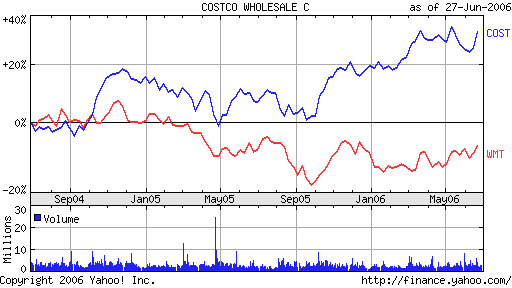
Yes, Another ADE Poll
From your friendly Adirondack Daily Enterprise: Are you in favor of a community-owned department store for Saranac Lake?
Current results (6/29):
Yes: 71.3%
No: 27.2%
Undecided: 1.5%
Now why would anyone be opposed to a community department store in Saranac Lake? A community department store certainly would not be competition to a Wal-Mart or other large retailer. The Comm. for the Advancement of Retail Development should be overjoyed with the thought of a new retail store. They are for advancement of retail development, says so right in their name.
Go here to read the comments left on the poll site.
It took a couple days, but the nastier comments are now arriving. The nasty comments seem to correlate with an uptick in the number of 'NO' voters.
UPDATE: So far approximately 90 comments. 44 of them generally in favor of a community department store and 45 opposed. More than half of those opposed to a CDS seem to think they have to write uncivil comments. I guess Wal-Mart really brings out the best in people.
Current results (6/29):
Yes: 71.3%
No: 27.2%
Undecided: 1.5%
Now why would anyone be opposed to a community department store in Saranac Lake? A community department store certainly would not be competition to a Wal-Mart or other large retailer. The Comm. for the Advancement of Retail Development should be overjoyed with the thought of a new retail store. They are for advancement of retail development, says so right in their name.
Go here to read the comments left on the poll site.
It took a couple days, but the nastier comments are now arriving. The nasty comments seem to correlate with an uptick in the number of 'NO' voters.
UPDATE: So far approximately 90 comments. 44 of them generally in favor of a community department store and 45 opposed. More than half of those opposed to a CDS seem to think they have to write uncivil comments. I guess Wal-Mart really brings out the best in people.
Tuesday, June 27, 2006
Hot Off the Press
Wrestling With Wal-Mart: Tradeoffs Between Profits, Prices and Wages by Bernstein, Bivens and Dube. Find the report here(pdf). You probably need to be a trained economist to understand the math in the appendix of this paper. You can also read a news release about the paper called 'The Wal-Mart debate A false choice between prices and wages' here.
To get a feel for how much of a wage increase could be financed out of reduced profit shares, one can imagine Wal-Mart's profit margins falling back down to their 1997 levels, which would also cut half of the difference between their margins and a key Wal-Mart competitor, Costco (which posted a profit margin of 2.0% in 2005). Reducing the profit margin by this much would give Wal-Mart $2.3 billion to plough into improved worker compensation without the need to raise prices. In Wrestling With Wal-Mart, we calculate that this would translate into just under $2,100 per non-managerial employee. Simply returning to its 1997 net profit margins, Wal-Mart could give its non-supervisory workers 13% pay increases without raising prices, while maintaining higher profit margins than a main competitor.
Wal-Mart could definitely raise compensation for its workers and still have lower prices than its competitors. Note that labor costs for its non-supervisory staff account for less than 7% of its total sales. If Wal-Mart's price advantage relative to its competitors is even in the neighborhood of what its defenders claim, consumers would still find Wal-Mart's prices lower. To believe otherwise is to believe that Wal-Mart's price advantage comes completely from substandard worker pay and not through any cost efficiencies.
Wal-Mart does a lot right. It has expanded productivity by being more efficient and leaner than many other companies. Many of the benefits shoppers accrue from Wal-Mart's expansion could be preserved even if the retailer had to meet the expectations of its critics regarding fair worker compensation. Defenders of the company too often set up false dichotomies such as low prices vs. high wages when in reality, better compensation for workers won't negate Wal-Mart's competitive edge.
Good Wal-Mart Debate at Slate
Barbara Ehrenreich, ex-Wal-Mart employee, author of Nickle and Dimed a story about how she lived a low wage earners life debates economist Jason Furman, author of Wal-Mart: A progressive success story.
Barbara makes some good points:
Jason counters:
Barbara:
I believe this debate goes on all week.
Barbara makes some good points:
And it is because we appreciate the low prices that we are not yelling: Stamp out the Beast! Crush it before it can bud off yet another Super Store!We are saying, pretty calmly for the most part: Why can't it be better? Why can't it offer decent-paying jobs as well as low prices, especially if it's such a genius, as you say, at increasing productivity?
The problem isn't Wal-Mart, we critics like to say, it's the Wal-Martization of the entire economy, which involves not only low wages at Wal-Mart itself but depressed wages throughout the company's whole supply chain as well as at competing companies (e.g., supermarkets).
Jason counters:
Maybe you're ready to grant my point that Wal-Mart's low prices are great for the 298 million Americans who don't work there. But what about the 1.3 million Americans who do work for Wal-Mart? Here the evidence is murkier, in part because Wal-Mart refuses to release the data on its wages and benefits that could clear up a number of questions. What we do know is that its wages and benefits are about average for the retail sector—which is to say, not so great.Sounds like he is saying big box stores are there to provide jobs to dummies.
But I understand why progressives are so upset about low wages and inadequate benefits. I am also upset by the rise of inequality and the relatively slow economic progress that the bottom 80 percent of Americans have made over the last several decades. I just think Wal-Mart is the wrong place to put the blame or to expect the solution.
Now imagine that Best Buys across the country were replaced by Stereo Exchanges. We would have more "good jobs" and fewer "bad jobs." The average wage in the electronics retail sector would go up. But where would all the former Best Buy workers go? Most of them wouldn't work at Stereo Exchange. Maybe some would take a pay cut and work at McDonalds.
Barbara:
I'm a little baffled by your Best Buy/Stereo Exchange example. If Stereo Exchange took over from Best Buy, there'd be a lot more better-paying jobs in the retail electronics business. Why wouldn't the former Best Buy workers take a lot of these new and better jobs? They're not all as clueless as you seem to think.Why can't more people understand this point?
You ask, in so many words, why pick on Wal-Mart when there are so many equally Scrooge-like employers around? Why not go after, say, the bodega on the corner? Well, the question answers itself. By gobbling up thousands of acres of farmland and suburban sprawl to feed its relentless appetite for growth, recruiting (and spitting out) thousands of workers a day, and achieving near-monopoly status in some parts of the country, Wal-Mart has made itself into an unmissable target for anyone concerned about poverty and mounting inequality. The bodega may be bad—not to mention any number of retail chains other than Wal-Mart—but you might as well start with the biggest piggy of all, which is the largest single private employer in America.
You're arguing, essentially, that whatever misery Wal-Mart workers endure is compensated for by the low prices Wal-Mart consumers enjoy. The same could be said of other workers who provide services to working-class people, like those in the fast-food and child-care industries: Their atrocious wages help keep prices low for impecunious parents and burger-eaters. In other words, the working class can only advance on the backs of (some of) its own members. Sacrifice one group to keep the others afloat, so that the class struggle is replaced by a kind of Darwinism internal to the working class.
I believe this debate goes on all week.
What is a Community Retail Store?
From some of the comments published on the ADE webpoll it seems there is some confusion about 'Community Retail Stores'.
A community department store is not a co-operative. You don't need to be a 'member', anyone can shop there.
A community department store is a corporation, owned by investors (restricted to community members) and overseen by a board of directors that are responsible to a set of bylaws.
If a community department store runs into financial difficulties, it is the investors that take the financial hit. Investors own shares of the corporation. Investors cannot be assessed additional monies.
What if a larger department store opens in the area causing financial problems to a community department store? Presumably the investors lose their money. A risk they were willing to take.
A community department store will just be like a Wisebuys or Dollar Store. Maybe, maybe not. If a community department store is not to your liking, you have the option of not shopping there.
The Powell Merc only pays their employees $6-7 per hour and no benefits. So what, Powell will not own our community department store. We can do what we think is right.
A community department store is not a community organization in the sense that it is a club, fraternal organization or even a volunteer fire department. It is a corporation, recognized by the state, owned by investors, who happen to be interested community members.
But Wal-Mart.... To hell with Wal-Mart. If Wal-Mart's financial future is dependent on locating in Saranac Lake, it is way too late to be concerned about them. They probably have the support to build a smaller store in the downtown area. This apparently does not interest them.
A community department store is not a co-operative. You don't need to be a 'member', anyone can shop there.
A community department store is a corporation, owned by investors (restricted to community members) and overseen by a board of directors that are responsible to a set of bylaws.
If a community department store runs into financial difficulties, it is the investors that take the financial hit. Investors own shares of the corporation. Investors cannot be assessed additional monies.
What if a larger department store opens in the area causing financial problems to a community department store? Presumably the investors lose their money. A risk they were willing to take.
A community department store will just be like a Wisebuys or Dollar Store. Maybe, maybe not. If a community department store is not to your liking, you have the option of not shopping there.
The Powell Merc only pays their employees $6-7 per hour and no benefits. So what, Powell will not own our community department store. We can do what we think is right.
A community department store is not a community organization in the sense that it is a club, fraternal organization or even a volunteer fire department. It is a corporation, recognized by the state, owned by investors, who happen to be interested community members.
But Wal-Mart.... To hell with Wal-Mart. If Wal-Mart's financial future is dependent on locating in Saranac Lake, it is way too late to be concerned about them. They probably have the support to build a smaller store in the downtown area. This apparently does not interest them.
Monday, June 26, 2006
Let's Be Civil
"Adirondack natives are intelligent, wise, hard-working and generous".
Generally speaking, yes. However, every now and then you get a letter like this one.
Unthinking letters are one thing, but this 'major retailer' issue has devolved into unknown persons leaving anonymous hate mail in a village trustee's mailbox. This is not only uncivil, it's against the law.
Generally speaking, yes. However, every now and then you get a letter like this one.
Unthinking letters are one thing, but this 'major retailer' issue has devolved into unknown persons leaving anonymous hate mail in a village trustee's mailbox. This is not only uncivil, it's against the law.

Friday, June 23, 2006
Stories on Community Store Public Forum - Saranac Lake
Thursday, June 22, 2006
Very Successful Public Forum Tonight!
Tonight was the night of the Public Forum about a community department store held at the Harrietstown Town Hall. There was quite a large audience of enthusiastic attendees. When asked how many people would buy shares in such a store (at $500 each) at least 100 people raised their hands.
Left to right: Steve Alves, Board Member, Greenfield, MA Mercantile; Nancy Neff, Stafford Springs, CT Community Store; Sharon Earhart, Chamber Director, Powell, Wyoming

Attentive Saranac Lake residents. Maybe 200-250 attendees, maybe more.
Steve Alves explains the legal process needed to sell shares in a community store venture.
I just realized that Steve Alves is the guy that made the movie 'Talking to the Wall'. Read more here. I also posted about this movie on 5/31 here.
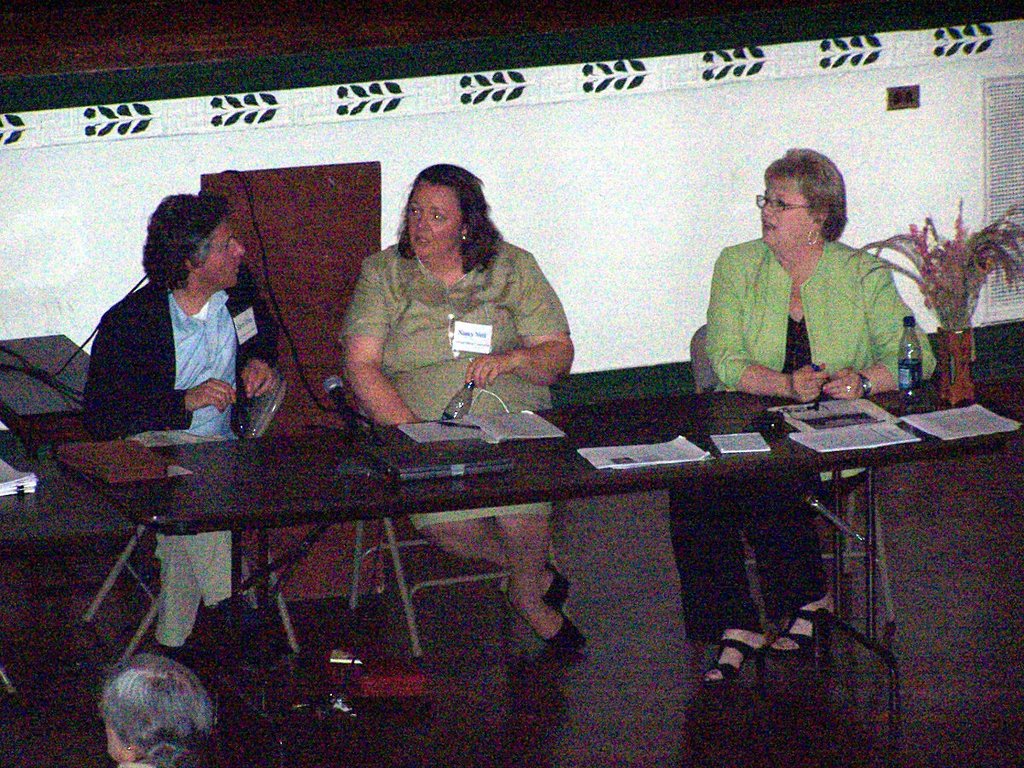
Left to right: Steve Alves, Board Member, Greenfield, MA Mercantile; Nancy Neff, Stafford Springs, CT Community Store; Sharon Earhart, Chamber Director, Powell, Wyoming
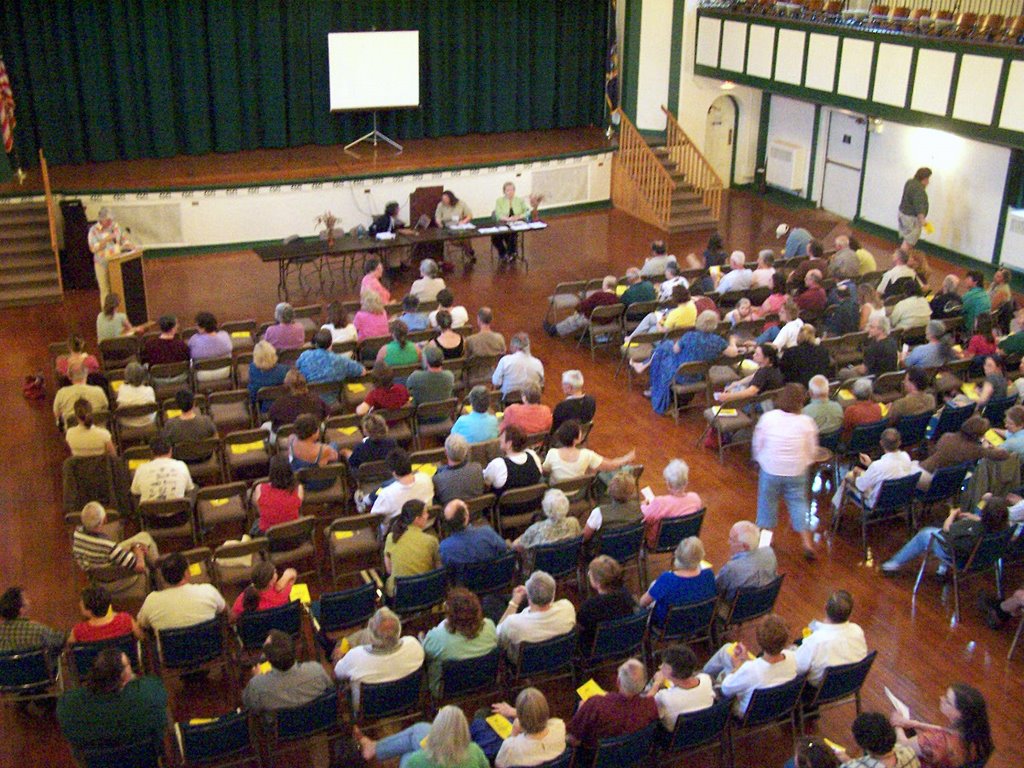
Attentive Saranac Lake residents. Maybe 200-250 attendees, maybe more.

Steve Alves explains the legal process needed to sell shares in a community store venture.
I just realized that Steve Alves is the guy that made the movie 'Talking to the Wall'. Read more here. I also posted about this movie on 5/31 here.
Powell, Wyoming 'Merc' - Some Info
The Merc opened in July 2002. The store sells affordably priced clothing and shoes for the whole family. With a Wal-Mart Supercenter just 20 miles away in Cody, some Powell residents predicted that The Merc, like most small town stores focused on basic needs, would fail.But so far the store has been remarkably successful. It's met vital local needs, boosted sales at other downtown businesses, and even turned a profit. During its first year, The Merc took in $500,000 in revenue, outpacing projections, and generated a profit of $36,000. The earnings were reinvested and used to expand the store from 7,500 to 10,000 square feet. Founders cite several factors in The Merc's success, including top-notch customer service and a board made up of experienced local businesspeople. With no debt to service or stockholders demanding high rates of return, prices can be kept relatively low. "We're probably not quite as low as Wal-Mart," said store manager Paul Ramos, "but we're close and we usually do better than the mall up in Billings." Another significant factor in The Merc's success, according to board member Ken Witzeling, is the community's sense of ownership. "When you walk down the street and talk to people about the store," he said, "they all refer to it as 'our store.' Not 'the store,' or 'that store.' It's 'our store.'
Read more here.
Also, an article in the Casper Star Tribune here.
"Everyone wants to know what we're doing and how we're doing it."
The answer to the first part of the question is "pretty good." It has been three years since 800 community investors plunked down one or more $500 shares to put The Merc in business. Last year, the community-owned business cleared $560,000 in gross sales and shareholders should see "sizeable" dividends in the next few years, said Ken Witzeling, a retired pharmacist who sits in the president's chair on The Merc's Board of Directors.
"We've made money since day one," Witzeling said.
Subscribe to:
Posts (Atom)